Air Conditioner Buying Guide India — How to Choose the Right AC
The 5 decisions that determine whether your AC purchase is a win or a regret — tonnage, star rating, type, condenser, and features. A visual overview with links to our deep-dive guides.
Buying an AC in India means making 5 decisions — and getting even one of them wrong can cost you thousands in electricity or leave you with a room that never cools properly. This overview covers the key factors, with links to our detailed guides on each topic.
1. Tonnage — Match It to Your Room or Regret It
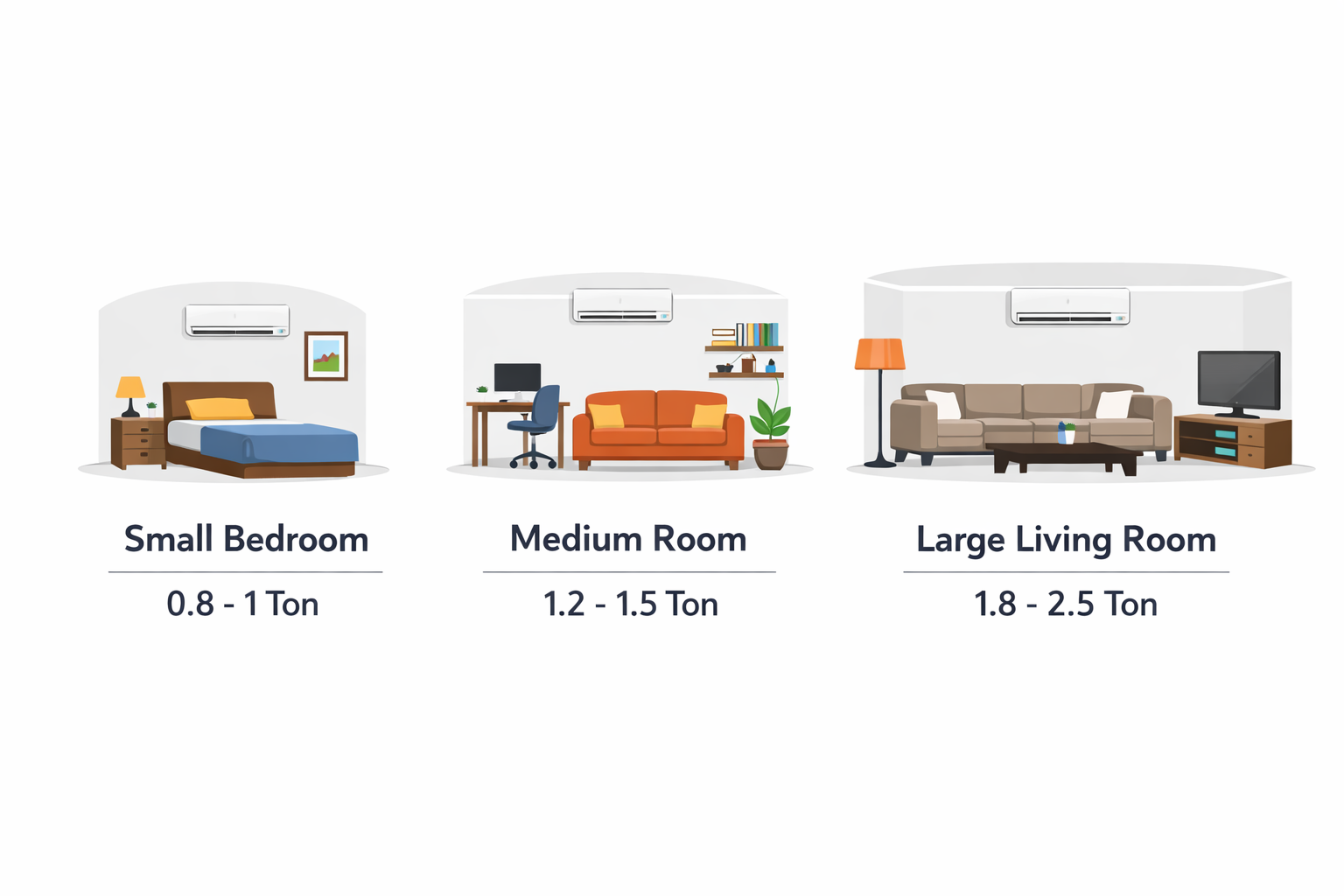
Tonnage is the cooling capacity of your AC. An undersized AC will run non-stop and still not cool the room. An oversized AC will short-cycle — cooling too fast, shutting off, restarting — wasting energy and wearing out the compressor.
| Room Size | Standard Floor | Top Floor / Sun-Facing |
|---|---|---|
| Under 120 sq ft | 1 Ton | 1 Ton or 1.5 Ton |
| 120–180 sq ft | 1.5 Ton | 1.5 Ton or 2 Ton |
| 180–300 sq ft | 2 Ton | 2 Ton |
Factors that push you one size up: top floor, direct afternoon sun, west-facing wall, large windows, kitchen adjacency, ceiling above 10 feet.
Calculate Your Exact Tonnage
Our tonnage calculator factors in room size, floor, sun exposure, and insulation to give you a precise recommendation.
Use the Tonnage Calculator →→2. Star Rating — 3-Star vs 5-Star Is a ₹2,000–3,000/Year Decision
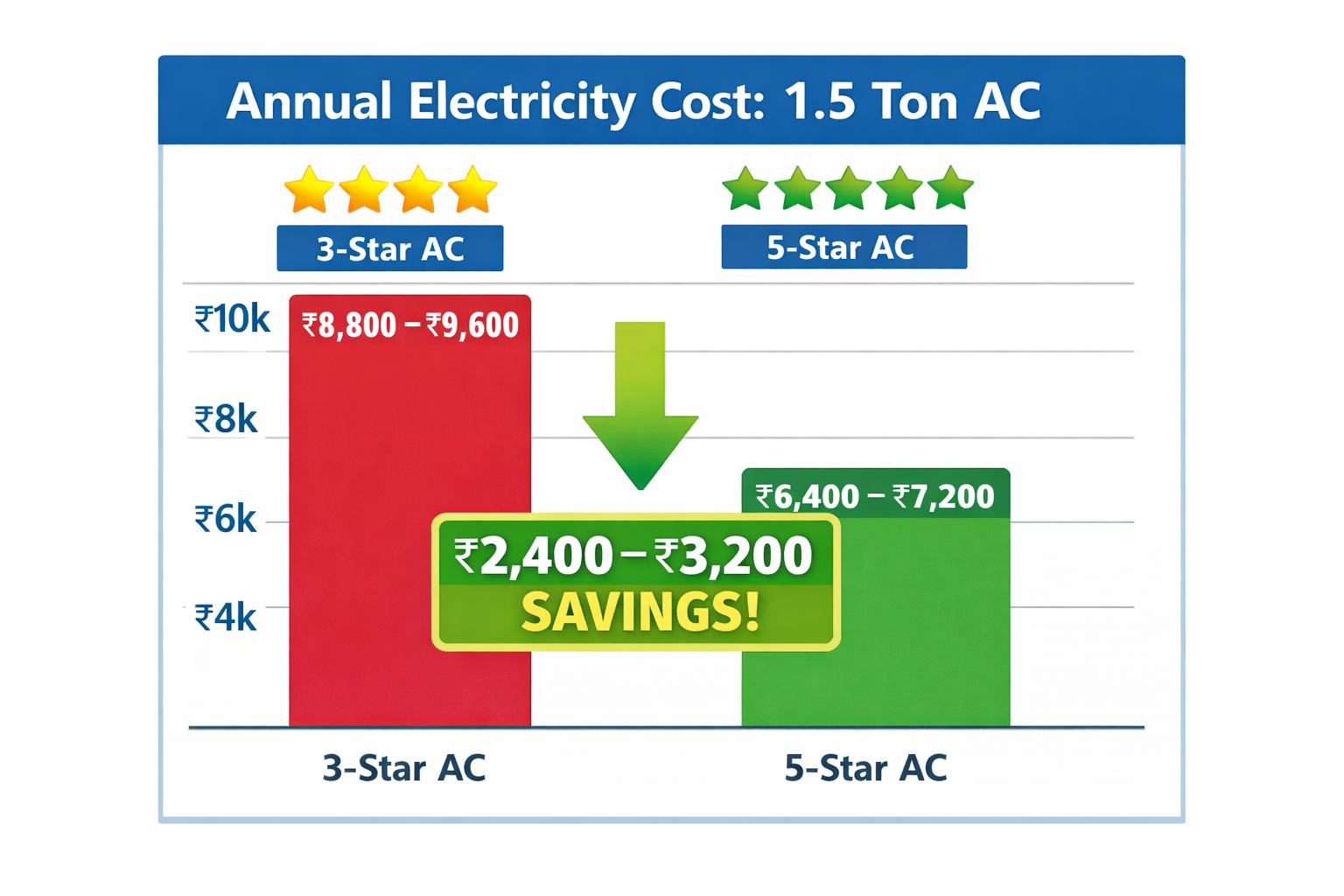
Star ratings are assigned by BEE (Bureau of Energy Efficiency) based on ISEER — the ratio of cooling output to energy consumed. Higher stars = lower electricity bills.
The quick maths for a 1.5-ton AC running 8 hours daily:
- 5-star: ~800–900 units/year → ₹6,400–7,200/year
- 3-star: ~1,100–1,200 units/year → ₹8,800–9,600/year
- Annual savings with 5-star: ₹2,400–3,200
The 5-star model costs ₹5,000–10,000 more upfront. If you run your AC 6+ hours daily, it pays for itself in 2–3 summers. If you use it under 5 hours daily or only seasonally, a 3-star model is the smarter financial choice.
Important: BEE revised star rating thresholds in January 2026. Some ACs labelled "5-star" on Amazon carry the old 2025 rating — effectively one star lower under current rules. Always check whether the rating is 2025 or 2026 on the product page.
5-Star vs 3-Star: The Full Breakdown
We calculated exactly when 5-star pays off and when 3-star is the better buy — based on usage hours, electricity rates, and upfront cost difference.
Read the Full Comparison →→3. Split AC vs Window AC — It Depends on Your Situation
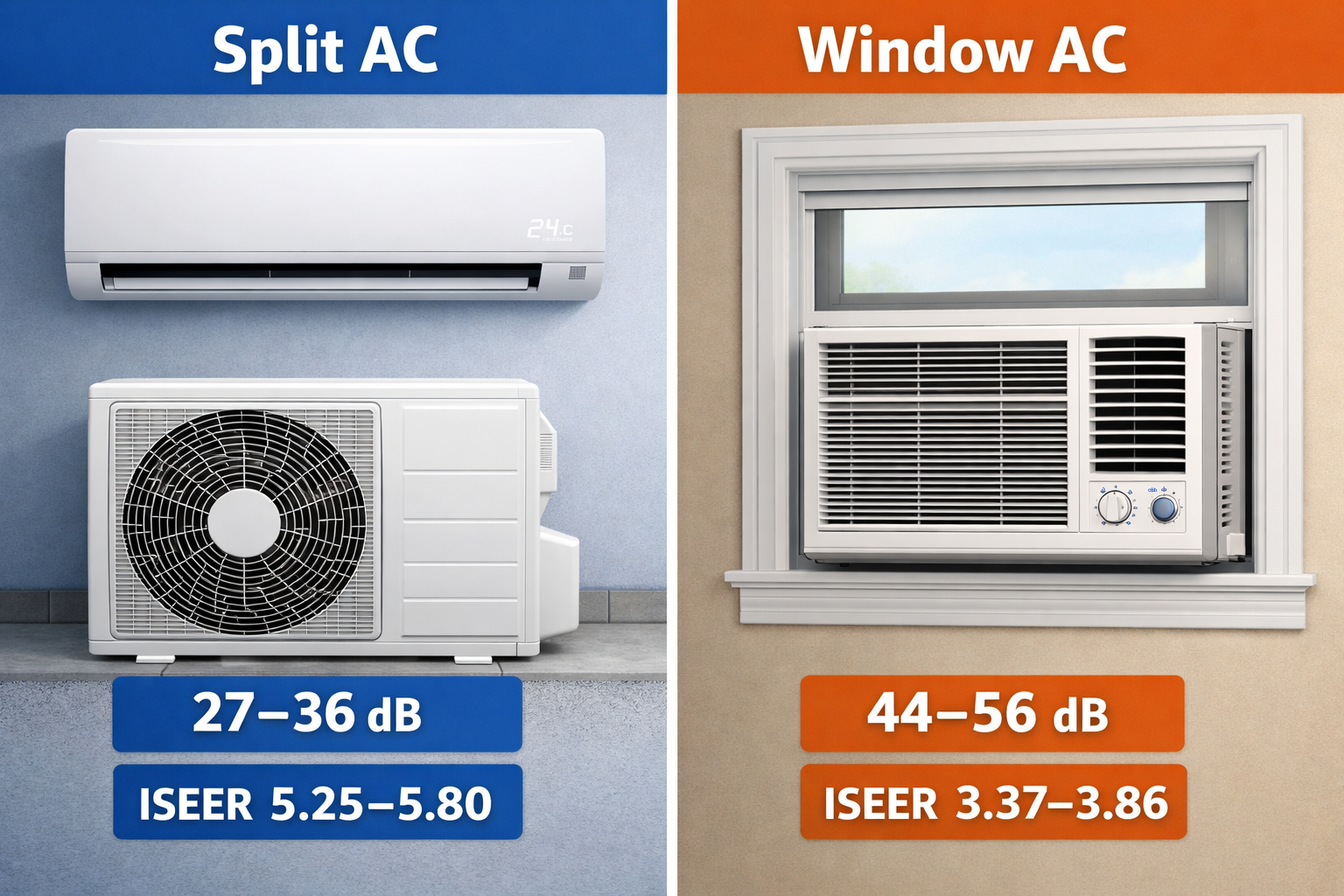
Split ACs dominate the market, but window ACs are making a comeback with modern inverter models.
| Split AC | Window AC | |
|---|---|---|
| Noise | 27–36 dB (whisper-quiet) | 44–56 dB (noticeable) |
| Efficiency | Higher ISEER (5.25–5.80) | Lower ISEER (3.37–3.86) |
| Installation | ₹2,000–4,000, needs wall drilling | ₹500–1,000, just a window slot |
| Best for | Bedrooms, living rooms | Rentals, old buildings, utility rooms |
Go split if noise matters (bedrooms), you want maximum efficiency, or you're in a permanent home. Go window if you're a renter, your building doesn't allow outdoor units, or budget is tight.
Split vs Window: The Full Guide
Installation practicalities, noise comparison, efficiency gap, and which makes sense for renters vs homeowners.
Read the Full Comparison →→4. Copper vs Aluminium Condenser — And Why the Coating Matters More
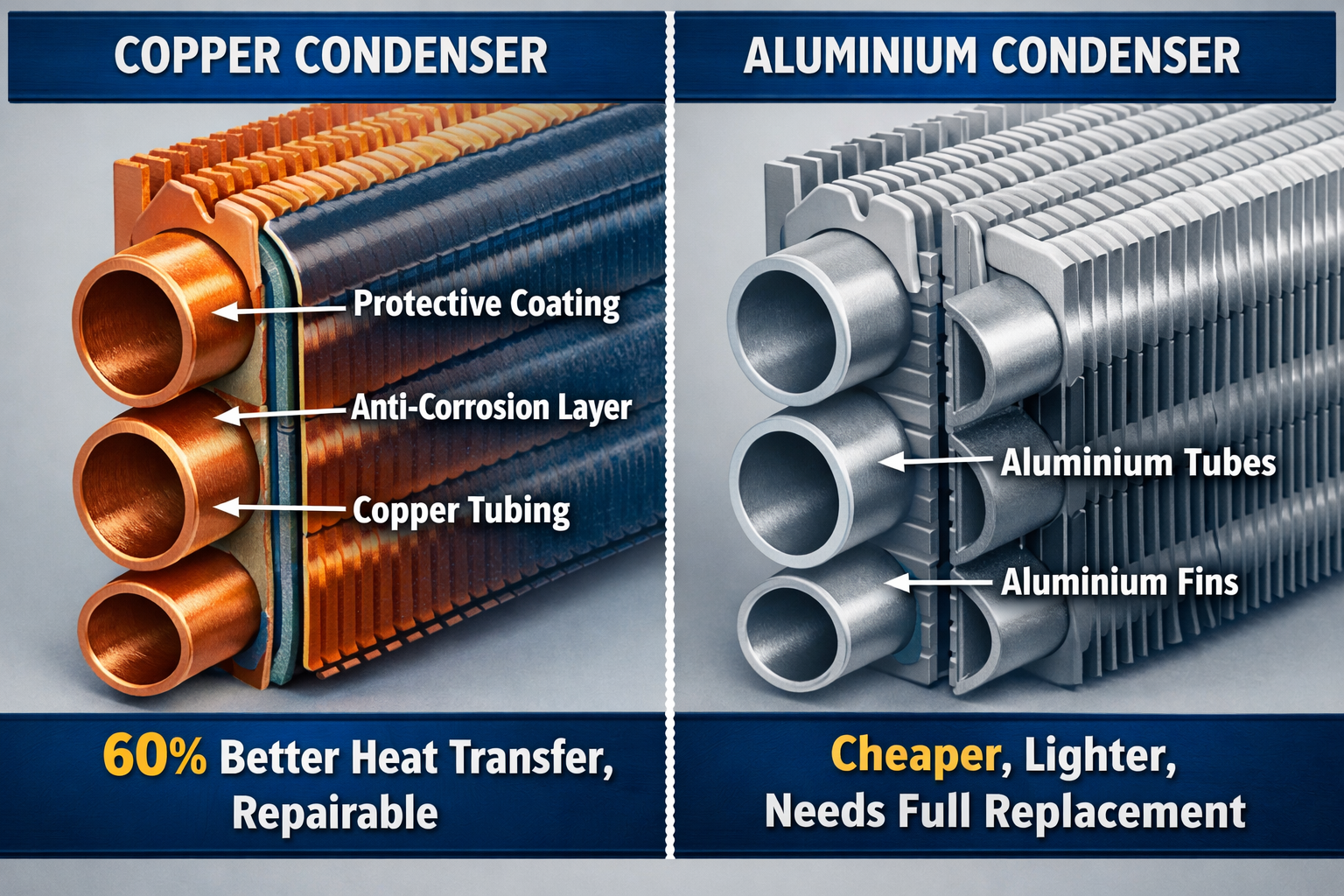
Every AC worth buying in 2026 uses a copper condenser. Copper transfers heat 60% better than aluminium and can be repaired on-site — aluminium condensers often need full replacement.
The real differentiator now is the anti-corrosion coating on the copper:
- Daikin DNNS — proven from commercial HVAC, excellent for coastal areas
- Panasonic ShieldBlu+ — multi-layer protection against salt and moisture
- LG Ocean Black Protection — best for salt air and industrial pollutants
- Blue Star Blue Fin — solid for humid environments
If you live within 5 km of the coast, near the sea, or in a high-humidity city (Mumbai, Chennai, Kolkata, Kerala) — the coating is more important than any other feature. Our detailed guide breaks down which coating suits your environment.
5. Inverter vs Non-Inverter — Always Go Inverter
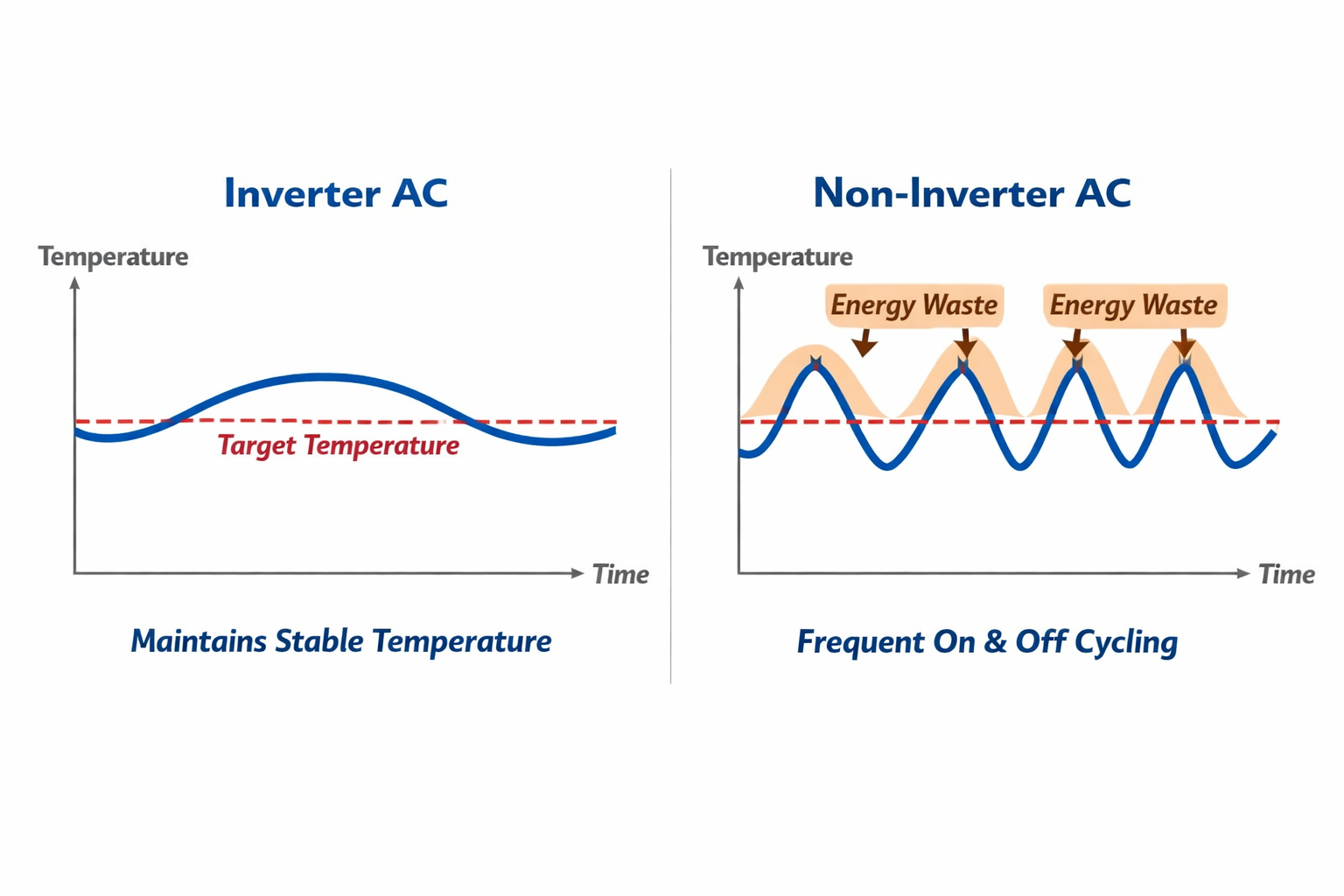
Non-inverter ACs run the compressor at full speed, then shut it off when the room cools, then restart — causing temperature swings, noise spikes, and higher bills. Inverter ACs adjust compressor speed continuously, maintaining a steady temperature.
The numbers are clear:
- 30–50% lower electricity consumption with inverter
- Quieter — no compressor cycling noise
- Longer compressor life — less mechanical stress
- Price gap in 2026: only ₹2,000–3,000
There is no scenario where a non-inverter makes sense in 2026. Our full inverter vs non-inverter guide covers the technical details.
6. Smart Features — Separate the Useful from the Marketing
AC brands pack their models with features that sound impressive in ads. Here's what actually matters:
Worth paying for:
- Convertible/variable tonnage (4-in-1, 5-in-1, 8-in-1) — runs at lower capacity when the room is small or occupancy is low. Genuine savings of 10–15%.
- Self-clean / auto-clean — reduces mould and bacteria on the evaporator. Cuts servicing frequency. Panasonic's DustBuster even cleans the outdoor unit.
- WiFi / app control — genuinely useful for pre-cooling your room before you get home. Look for Google Home/Alexa/Matter compatibility.
Nice to have, not worth a premium:
- Voice control (Alexa/Google) — sounds great in demos, but the remote is faster in practice.
- 4-way swing / 3D airflow — marginal improvement over standard 2-way swing.
Pure marketing — ignore:
- "AI cooling" — fancy name for a thermostat algorithm. Every inverter AC already adjusts output based on temperature.
- "Micro dust filter" / "PM 2.5 filter" — ACs are not air purifiers. These catch large dust at best. If air quality matters, buy a dedicated air purifier.
- Ionizers, vitamin C filters, fancy display panels — no measurable impact on cooling or air quality.
Bottom line: Spend your budget on the right tonnage, star rating, and copper condenser. Smart features are the last thing to optimise for.
7. Installation — The Cost Nobody Tells You About
Most brands advertise "free standard installation" — which typically means mounting the indoor unit and connecting it to the outdoor unit with 3 metres of included piping.
Anything beyond that costs extra:
| Item | Cost Range | When You'll Need It |
|---|---|---|
| Extra copper piping | ₹500–800/metre | Outdoor unit more than 3m from indoor |
| Core cutting (wall drilling) | ₹500–1,000 | No existing hole in the wall |
| Outdoor unit stand/bracket | ₹500–1,500 | Wall-mounted or ground-stand options |
| Drain pipe extension | ₹200–400 | Drain needs to reach a specific outlet |
| Voltage stabiliser | ₹1,500–3,000 | Areas with voltage fluctuations below 135V |
Budget ₹2,000–5,000 over the AC price for installation.
Placement tips:
- Indoor unit at least 7–8 feet from the floor for optimal air circulation
- Don't install directly above electronics — condensation drips happen
- Keep the outdoor unit shaded if possible — direct sun reduces efficiency by 5–10%
- Shorter piping = better efficiency. Minimise the distance between indoor and outdoor units
Common Mistakes to Avoid
Oversizing the AC. A 2-ton AC in a 120 sq ft room won't cool faster — it will short-cycle, waste energy, and wear out the compressor. Always match tonnage to your room.
Ignoring installation costs. The AC price isn't the full cost. Split AC installation runs ₹2,000–4,000 depending on piping length, copper vs aluminium piping, and electrical work. Pipe runs above 10 feet reduce efficiency. Plan installation before buying.
Buying based on brand alone. Brand loyalty costs money. A ₹34,000 Carrier 5-star can outperform a ₹42,000 LG 5-star in specific scenarios. Always compare ISEER ratings, noise levels, and features within your budget.
Trusting old star ratings. Check if the star rating is based on 2025 or 2026 BEE criteria. A "5-star" AC under 2025 rules may only be 4-star under the current 2026 thresholds.
Our Recommended Picks by Room Size
Once you've figured out your tonnage and star rating, here's where to go:
| Your Room | Best Roundup |
|---|---|
| Small bedroom (under 120 sq ft) | Best 1 Ton Split ACs |
| Medium room (120–180 sq ft) | Best 1.5 Ton 5 Star ACs |
| Large room (180+ sq ft) | Best 2 Ton Split ACs |
| Any room, window slot available | Best Window ACs |
Frequently Asked Questions
A 5-star 1.5-ton inverter AC uses about 70–80 units/month at 8 hours daily, costing ₹560–640 at ₹8/unit. A 3-star uses 90–100 units/month. Your actual cost depends on your state's electricity slab rates — higher slabs mean the 5-star savings are even larger.
Split ACs are quieter (27–36 dB vs 44–56 dB), more efficient, and better-looking. Window ACs are cheaper to buy and install, and don't need wall drilling. For bedrooms and living rooms, go split. For rentals, old buildings, or utility rooms, window works fine. See our full split vs window AC guide for details.
Professional servicing twice a year — once before summer (March) and once after monsoon (October). Clean the indoor filters yourself every 2 weeks during heavy use. ACs with auto-clean features (like Panasonic's DustBuster) reduce but don't eliminate the need for professional servicing.
No single brand is best across all segments. Daikin and Panasonic lead on build quality and efficiency. Samsung offers the best smart features and warranty (5-year comprehensive). LG has the widest service network. Carrier offers the best value. Blue Star has the strongest commercial HVAC heritage. Compare within your budget rather than defaulting to a brand.
ISEER (Indian Seasonal Energy Efficiency Ratio) measures how efficiently an AC converts electricity into cooling across a full season — not just at peak load. Higher ISEER = lower electricity bills. Two ACs can both be '5-star' but differ by 0.5 in ISEER, translating to ₹400–600/year in electricity cost difference. Always compare ISEER values, not just star ratings.