5 Star vs 3 Star AC: Is the Extra Cost Worth It?
A 5-star AC costs ₹8,000–12,000 more. We break down exactly when it pays off and when a 3-star is the smarter buy.
A 5-star 1.5 ton AC costs ₹38,000–48,000. The 3-star version of the same model costs ₹30,000–38,000. That's an ₹8,000–12,000 premium. Whether it's worth it depends on exactly one thing: how many hours you run your AC per day and for how many months per year.
This guide gives you the math so you can make the decision in five minutes. No brand recommendations, no marketing spin — just the numbers.
Key Decision Factors
1. What Star Ratings Actually Measure
The BEE (Bureau of Energy Efficiency) star rating is based on a metric called ISEER — Indian Seasonal Energy Efficiency Ratio. It measures how many watts of cooling the AC produces per watt of electricity consumed, averaged across an entire Indian summer season.
| Star Rating | ISEER Range (2025-26 norms) | What It Means |
|---|---|---|
| 1 Star | 3.30–3.49 | Barely legal efficiency. Rarely sold. |
| 2 Star | 3.50–3.99 | Budget tier. High running costs. |
| 3 Star | 4.00–4.49 | Mid-range. Good value for moderate usage. |
| 4 Star | 4.50–4.64 | Uncommon. Few models target this rating. |
| 5 Star | 4.65+ | Maximum efficiency. Lowest running cost. |
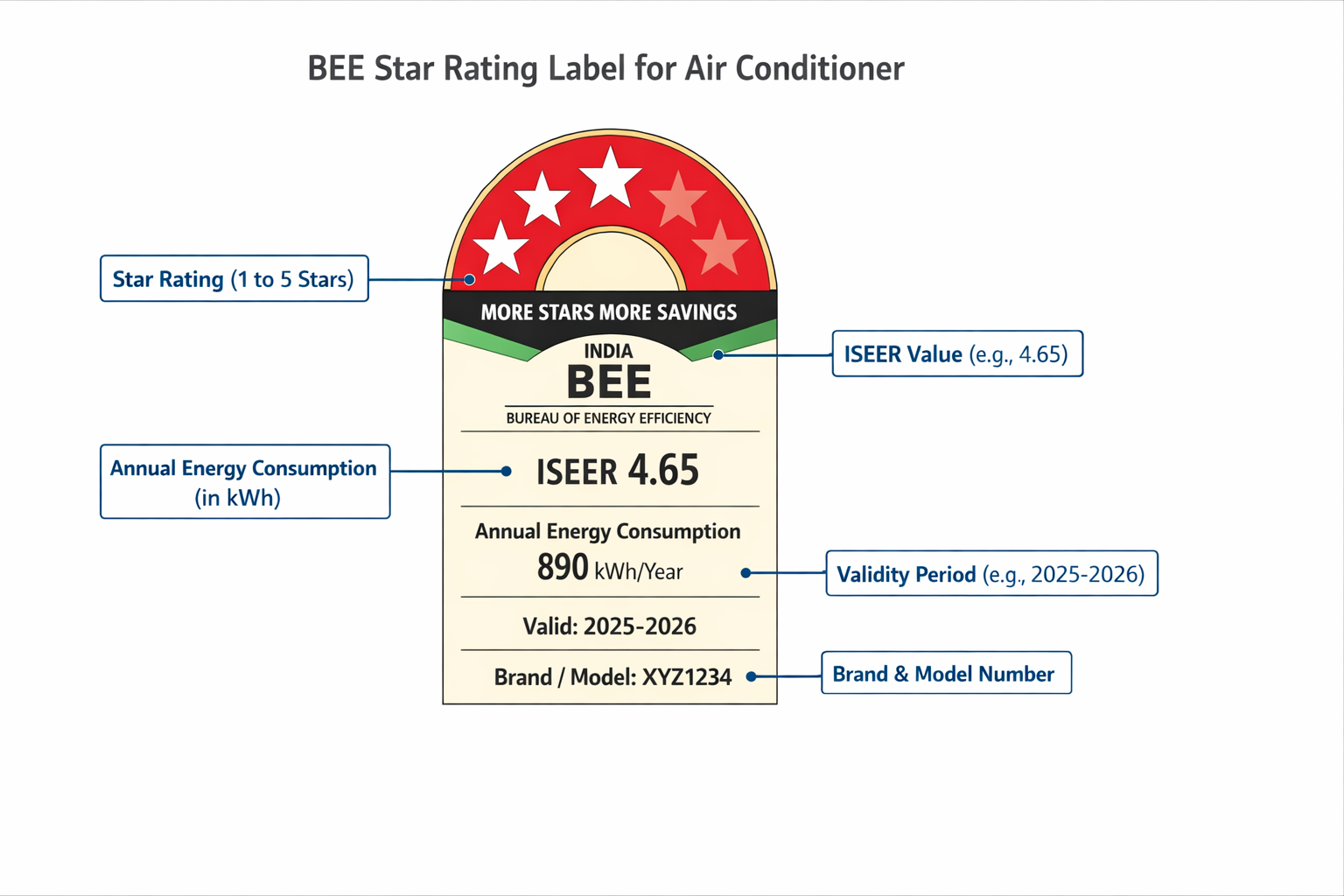
Important: BEE revises these thresholds every 2–3 years. A "5-star" AC from 2023 might only qualify as 3-star under 2025-26 norms. The label is the same but the standard has moved. Always check the validity period on the BEE label.
2. The Monthly Electricity Math
Here's where the decision gets concrete. All calculations assume ₹8/unit (average Indian domestic rate) and a 1.5 ton inverter split AC:
| Daily Usage | 3-Star Monthly Cost | 5-Star Monthly Cost | Monthly Savings | Annual Savings (5 months) |
|---|---|---|---|---|
| 4 hours/day | ₹1,050 | ₹750 | ₹300 | ₹1,500 |
| 6 hours/day | ₹1,575 | ₹1,125 | ₹450 | ₹2,250 |
| 8 hours/day | ₹2,100 | ₹1,500 | ₹600 | ₹3,000 |
| 10 hours/day | ₹2,625 | ₹1,875 | ₹750 | ₹3,750 |
| 12 hours/day | ₹3,150 | ₹2,250 | ₹900 | ₹4,500 |
| 16 hours/day | ₹4,200 | ₹3,000 | ₹1,200 | ₹6,000 |
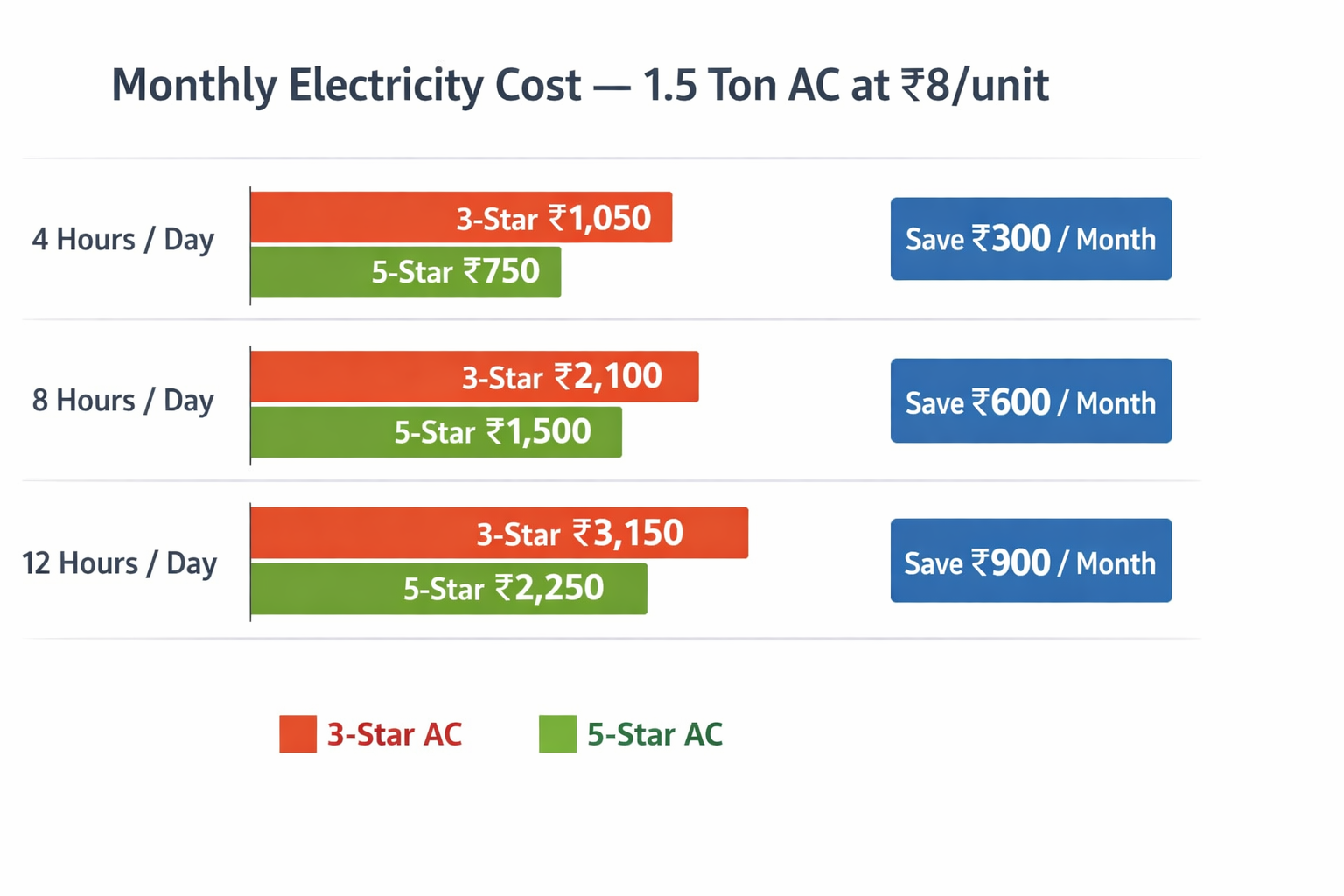
State-wise adjustment: Electricity rates vary significantly. Mumbai pays ₹9–12/unit at higher slabs, Goa pays ₹4–5/unit. If you're in a high-rate state, the savings from 5-star increase proportionally.
3. Break-Even Analysis — When Does the 5-Star Premium Pay Off?
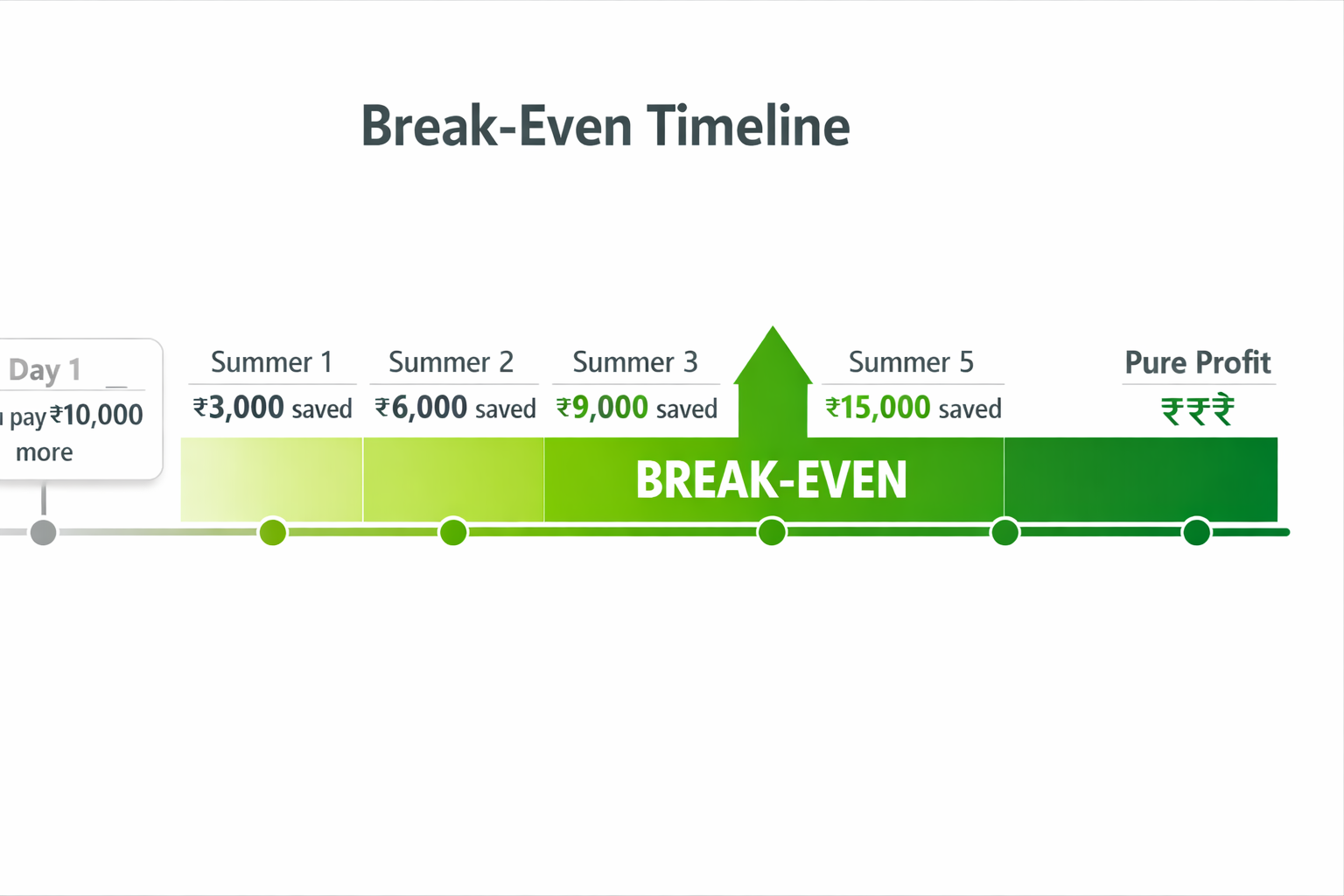
The upfront premium for 5-star over 3-star is typically ₹8,000–12,000 for the same brand and model line. Here's how long it takes to recover that through electricity savings:
| Daily Usage | Break-Even Period (₹10,000 premium) |
|---|---|
| 4 hours/day | 6–7 summers |
| 6 hours/day | 4–5 summers |
| 8 hours/day | 3–4 summers |
| 10 hours/day | 2–3 summers |
| 12+ hours/day | 1–2 summers |
The decision framework:
- 8+ hours daily, 5+ months/year → 5-star. It pays for itself within 3 summers and saves ₹30,000–60,000 over the AC's lifetime. This is the clear-cut scenario.
- 6–8 hours daily, 4–5 months/year → 5-star if you can afford the upfront cost. Break-even in 4–5 summers, which is well within the AC's lifespan.
- 4–6 hours daily, 3–4 months/year → 3-star offers better total value. The break-even stretches to 6+ years, and by then you might replace the AC anyway.
- Under 4 hours daily or seasonal/guest room → 3-star, without question. You'll never run it enough for the 5-star premium to justify itself.
4. The Hidden Factor: Electricity Slab Rates
Indian electricity billing uses progressive slabs — the more you consume, the higher the per-unit rate. This makes the 5-star advantage larger than the simple math suggests.
Example using a typical state tariff:
- 0–100 units: ₹4/unit
- 101–200 units: ₹6/unit
- 201–300 units: ₹8/unit
- 301+ units: ₹10/unit
A 3-star AC consuming 300 units/month pushes your household into the highest slab for everything — including your fridge, lights, and fans. A 5-star AC consuming 200 units keeps you one slab lower, saving you money on your entire electricity bill, not just the AC portion.
This slab effect can double the effective savings in states with steep progressive tariffs (Maharashtra, Karnataka, Tamil Nadu).
5. What About 4-Star ACs?
Very few models target the 4-star rating. Most brands produce 3-star (value segment) and 5-star (premium segment) and skip 4-star entirely. The reason is simple: the manufacturing cost difference between 4-star and 5-star is small, so it doesn't make commercial sense to offer an intermediate option.
If you find a 4-star model that's priced significantly below 5-star equivalents, it can be a reasonable middle ground. But don't go searching for one — the selection is limited and availability is spotty.
6. Star Rating vs Tonnage: Which Matters More?
If you're choosing between the right tonnage at 3-star or wrong tonnage at 5-star, always pick the right tonnage.
A 1-ton 5-star AC in a 170 sq ft room will run at maximum capacity constantly, negating its efficiency advantage entirely. A 1.5-ton 3-star AC in the same room will cycle normally and deliver better comfort at a lower total electricity cost.
Get the tonnage right first. Then optimise for star rating within your budget.
Common Mistakes to Avoid
Comparing star ratings across different tonnages — A 1-ton 5-star AC uses less electricity than a 1.5-ton 5-star AC. That doesn't mean you should buy a 1-ton for a room that needs 1.5-ton. Star rating compares efficiency within the same tonnage class — not across tonnages.
Trusting outdated BEE labels — If you're buying a 2024 model in a clearance sale, check the BEE label validity period. A "5-star" from the 2022-23 cycle may only be 3-star under current norms. The label should show "Valid: 2025-2026" or later for current standards.
Ignoring the slab rate effect — People calculate savings at a flat ₹8/unit, but if the 3-star AC pushes your household consumption into a higher slab, the real cost difference is much larger. Check your state's slab structure before deciding.
Choosing 5-star for a guest room — A guest room AC that runs 20–30 days a year will never recover the 5-star premium. Save the ₹10,000 and put it toward a better tonnage or copper condenser on your primary bedroom AC instead.
See our top-rated 5-star ACs
We've tested and scored the best 1.5 ton 5-star inverter ACs available in India.
View Best 5 Star ACs →→Frequently Asked Questions
At 8 hours daily usage and ₹8/unit electricity rate, a 5-star 1.5 ton AC saves approximately ₹600/month or ₹3,000 per summer season compared to a 3-star model. Over the AC's 8–10 year lifespan, this adds up to ₹24,000–30,000 in savings — well above the ₹8,000–12,000 upfront premium.
Not at all. A 3-star inverter AC in 2026 is more efficient than a 5-star model from 2022. It's a perfectly good choice for moderate usage (under 6 hours daily), guest rooms, or situations where upfront budget is tight. The star rating determines efficiency, not cooling quality — a 3-star AC cools just as well as a 5-star of the same tonnage.
Yes. BEE revises the ISEER thresholds every 2–3 years. Each revision raises the bar, so a 5-star AC from 2023 might only qualify as 3-star under 2025-26 norms. Always check the validity period printed on the BEE label. This means today's 5-star ACs are genuinely more efficient than older 5-star models.