Split AC vs Window AC: Which Is Right for You?
Split ACs dominate the market, but window ACs still make sense in specific situations. Here's how to decide based on your room, budget, and living situation.
Split ACs account for over 80% of AC sales in India. But window ACs haven't disappeared — they still sell millions of units annually, particularly in tier-2 cities and rental properties. The right choice depends on your room setup, ownership situation, and how much you're willing to spend on installation.
This guide covers the real trade-offs — not just the spec sheet differences, but the practical, India-specific factors that actually affect your decision.
Key Decision Factors
1. Cooling Performance — Split Wins, But Not By As Much As You Think
A split AC and a window AC of the same tonnage deliver identical cooling capacity — 1.5 tons is 1.5 tons regardless of form factor. The difference is in how efficiently they do it and how evenly they distribute air.
Split AC advantages:
- Inverter compressors (standard in split, rare in window) enable 30–50% better energy efficiency
- Indoor unit can be wall-mounted centrally for more even air distribution
- Longer air throw — the indoor unit's fan is designed for directed airflow across the room
Window AC realities:
- Cools from one corner of the room, creating uneven temperature zones
- Most models are still non-inverter (fixed-speed), meaning higher electricity consumption
- Adequate for rooms up to 120 sq ft; struggles with larger or irregularly shaped rooms
Bottom line: For rooms over 120 sq ft or daily usage of 6+ hours, a split AC's better air distribution and inverter efficiency make a meaningful difference in comfort and electricity cost.
2. Installation — The Factor Most People Underestimate
This is where the split vs window decision gets complicated in practice.
Window AC installation:
- Slides into any window opening (standard Indian window size works)
- Takes 30 minutes to install
- No wall drilling, no outdoor unit mounting, no copper piping
- Total installation cost: ₹500–1,000
- You can uninstall and move it yourself
Split AC installation:
- Requires wall drilling (core cutting) for piping
- Outdoor unit needs a wall bracket or ground stand
- 3 metres of copper piping included; extra piping costs ₹500–800/metre
- Professional installation takes 2–4 hours
- Total installation cost: ₹2,000–5,000 over the AC price
- Moving it to a new home costs ₹2,000–4,000 for uninstallation and reinstallation
| Factor | Window AC | Split AC |
|---|---|---|
| Installation time | 30 minutes | 2–4 hours |
| Installation cost | ₹500–1,000 | ₹2,000–5,000 |
| Relocation cost | ₹500–1,000 | ₹2,000–4,000 |
| Wall drilling required | No | Yes |
| Outdoor unit | Self-contained | Separate unit on wall/ground |
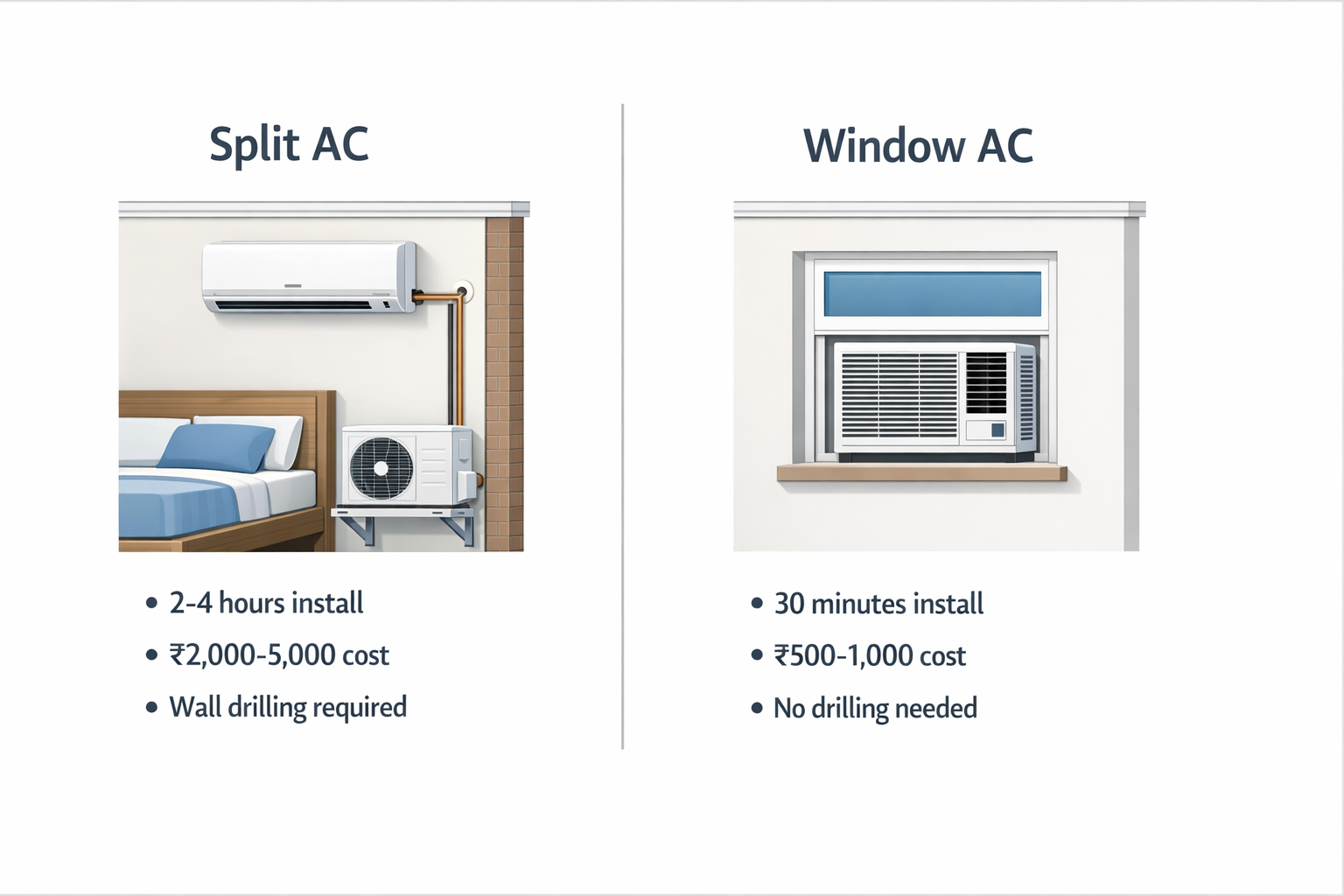
For renters: If your landlord won't allow wall drilling, or if you move every 1–2 years, the installation economics strongly favour a window AC.
3. Noise — Split ACs Are Significantly Quieter Indoors
A window AC puts the compressor right in your room. Even with insulation, indoor noise levels are 48–55 dB — comparable to a normal conversation. You'll hear it clearly while watching TV or trying to sleep.
A split AC keeps the compressor outside. The indoor unit produces just 26–36 dB at low fan speed — barely audible. The outdoor unit generates 50–55 dB, but that's outside your window.
| Window AC | Split AC (Indoor) | Split AC (Outdoor) | |
|---|---|---|---|
| Noise level | 48–55 dB | 26–36 dB | 50–55 dB |
| Comparable to | Normal conversation | Quiet library | Window AC |
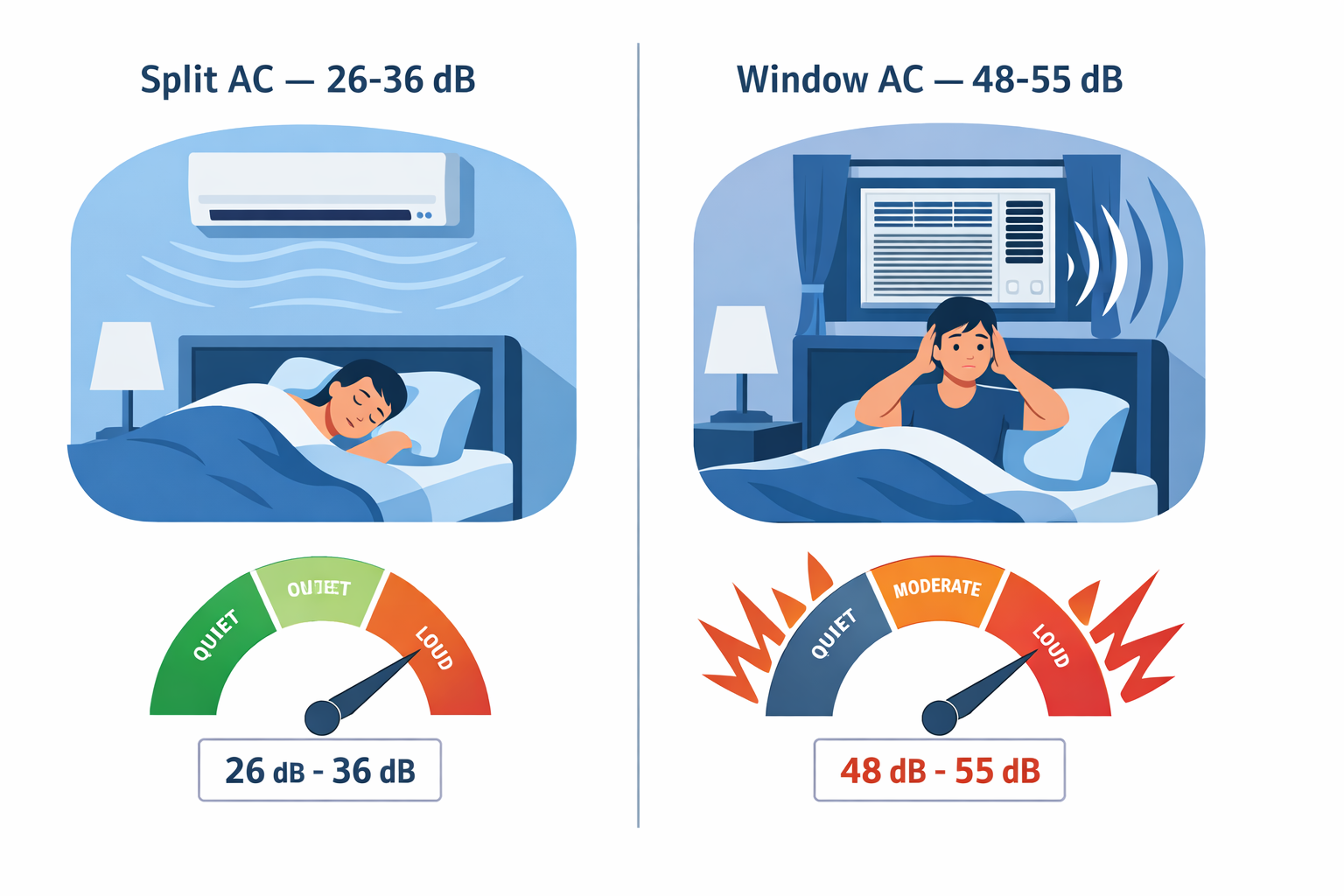
If this AC goes in a bedroom, the noise difference is a deal-breaker for most people. For a kitchen or rarely-used guest room, it matters less.
4. Price Comparison — Total Cost of Ownership
Looking at sticker price alone is misleading. Here's the real comparison for a 1.5 ton AC:
| Cost Component | Window AC (non-inverter) | Split AC (3-star inverter) | Split AC (5-star inverter) |
|---|---|---|---|
| Purchase price | ₹22,000–28,000 | ₹30,000–38,000 | ₹38,000–48,000 |
| Installation | ₹500–1,000 | ₹3,000–5,000 | ₹3,000–5,000 |
| Monthly electricity (8 hrs/day) | ₹2,800–3,400 | ₹2,100–2,500 | ₹1,500–1,900 |
| 3-year electricity (5 months/yr) | ₹42,000–51,000 | ₹31,500–37,500 | ₹22,500–28,500 |
| 3-year total cost | ₹64,500–80,000 | ₹64,500–80,500 | ₹63,500–81,500 |
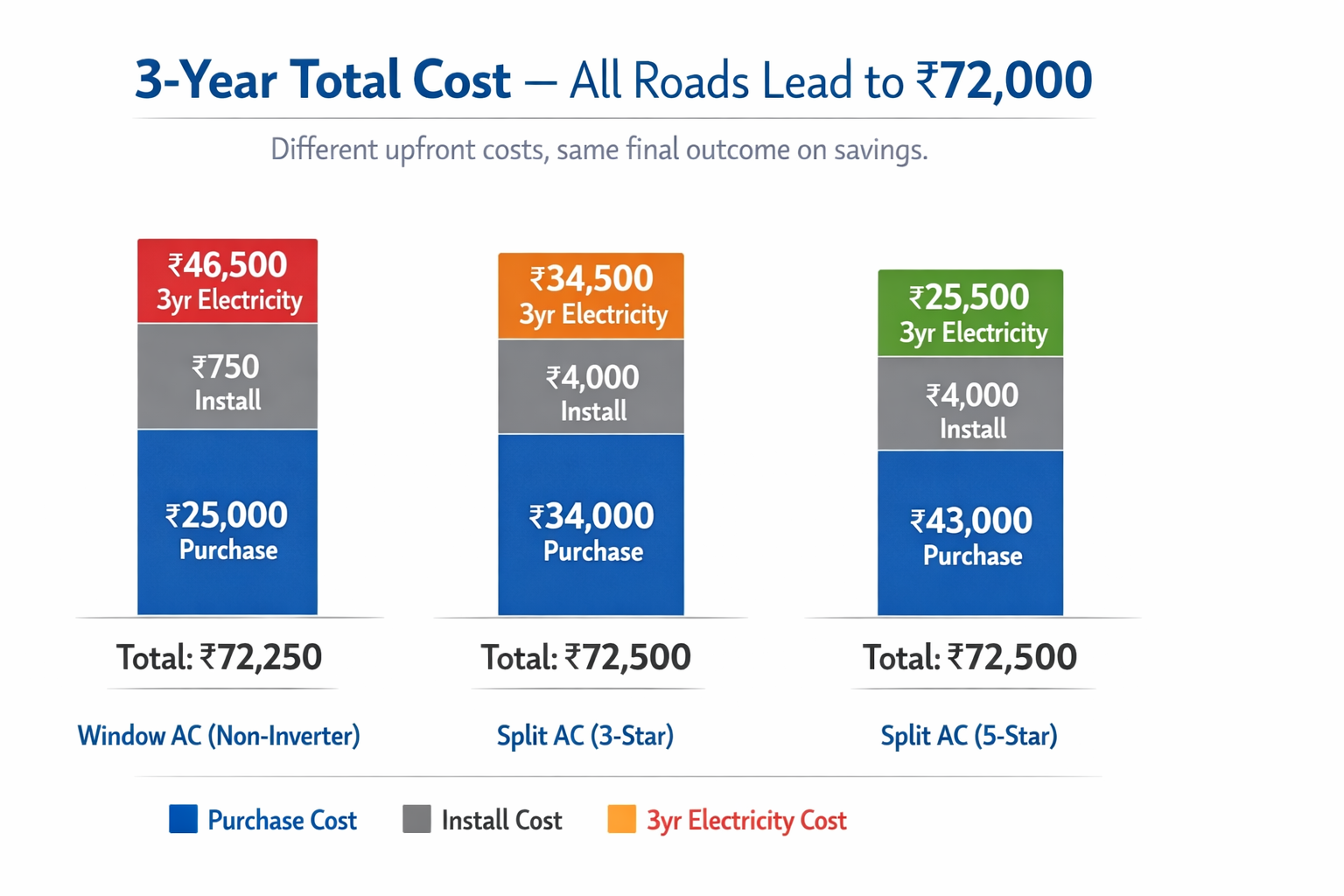
The 3-year total cost is remarkably similar. The window AC is cheaper upfront but its higher electricity consumption catches up quickly. Over 5+ years, the split AC (especially 5-star) becomes definitively cheaper.
5. Aesthetics and Space
Window ACs occupy a window opening, blocking natural light and ventilation from that window. The unit protrudes both inside and outside. In modern apartments with sealed aluminium windows, finding a compatible window can be a problem.
Split ACs have a slim indoor unit mounted high on the wall, barely noticeable. The outdoor unit is out of sight. They don't block any windows.
In terms of interior aesthetics, this isn't even a contest. If your home's look matters to you, a split AC is the only option.
6. Maintenance and Repairs
Window ACs are simpler machines. Fewer components, no refrigerant piping between units, and any AC technician can service them. Repairs are typically cheaper — common issues cost ₹1,000–3,000.
Split ACs have more components that can fail — the refrigerant line, electronic control board, inverter circuit, drain pipe. Repairs cost ₹2,000–6,000 on average. However, the inverter compressor (the most expensive component) typically comes with a 10-year warranty.
Gas refilling: Window ACs are more prone to refrigerant leaks at the unit's joints. Split ACs can develop leaks in the copper piping, especially if the installation was poor. Either way, gas refilling costs ₹1,500–2,500.
Common Mistakes to Avoid
Buying a window AC for a large room to save money — A 1.5 ton window AC in a 180 sq ft room will cool unevenly and run the compressor at full tilt constantly. The electricity waste negates any upfront savings. If the room needs 1.5 tons, a split AC is the better investment.
Ignoring the window requirement — Modern apartments often have sliding aluminium windows that can't accommodate a window AC. Before buying, measure your window opening. You need a minimum opening of 22 inches (width) × 16 inches (height). If no window works, a split AC is your only option.
Not factoring in relocation costs for renters — If you move every 2 years, you'll spend ₹4,000–8,000 on split AC uninstallation and reinstallation each time. Over 3 moves, that's ₹12,000–24,000 — enough to have bought a decent window AC instead.
Choosing a window AC for the bedroom — The noise difference between a window AC (50+ dB) and a split AC indoor unit (28–35 dB) is enormous at 2 AM. If sleep quality matters, the split AC premium is worth it for the bedroom.
See our top-rated split ACs
Our scored rankings of the best 1.5 ton split ACs in India, tested for cooling, efficiency, and noise.
View Best Split ACs →→Frequently Asked Questions
No. While window ACs cost ₹8,000–15,000 less upfront, their higher electricity consumption (most are non-inverter) closes the gap within 2–3 years. Over 5+ years, a split AC with inverter technology is typically cheaper in total cost of ownership. The window AC only wins financially if you use it very lightly (under 4 hours daily) or move frequently.
You can, but it requires wall drilling for piping and an outdoor unit bracket, which most landlords need to approve. You'll also spend ₹2,000–4,000 on uninstallation when you move out. For short-term rentals (under 2 years), a window AC may be more practical unless your landlord is flexible about installation.
A few brands (Hitachi, LG) offer inverter window ACs in India, but the selection is very limited compared to split ACs. Prices start around ₹28,000–32,000 for 1 ton. If you specifically need a window AC but want inverter efficiency, check availability before assuming you can find one in your preferred tonnage.