Copper vs Aluminium Condenser in ACs: Does It Actually Matter?
AC brands push copper condensers as premium. Here's when copper genuinely matters, when aluminium is fine, and how to decide based on where you live.
The condenser coil sits inside your AC's outdoor unit. It's the component that releases heat from your room into the outside air. Every AC brand makes a big deal about whether this coil is copper or aluminium — and charges ₹2,000–4,000 more for copper. But the answer to "which is better" depends almost entirely on your geography.
If you live within 50 km of the coast, buy copper. If you live in a dry inland city, aluminium is fine. That's the short version. The rest of this guide explains why.
Key Decision Factors
1. Heat Transfer — Copper's Technical Advantage
Copper conducts heat 60% better than aluminium. In practical terms, this means a copper condenser dissipates heat from the refrigerant faster, which makes the AC marginally more efficient.
| Property | Copper | Aluminium |
|---|---|---|
| Thermal conductivity | 385 W/mK | 237 W/mK |
| Heat transfer efficiency | Baseline | 20–30% lower |
| Impact on electricity bill | — | 3–5% higher consumption |
However, manufacturers compensate for aluminium's lower conductivity by using larger coils and more fins. A well-designed aluminium condenser can match copper's heat transfer at the system level. The 3–5% efficiency gap exists in controlled tests but shrinks in real-world conditions.
Practically: the heat transfer difference alone does not justify a ₹3,000–4,000 premium. If efficiency were the only factor, aluminium would be fine for everyone.
2. Corrosion Resistance — Where Geography Makes the Decision
This is the real reason copper matters, and it has nothing to do with cooling performance.
Aluminium corrodes aggressively in:
- Coastal areas (salt air attacks aluminium within 2–3 years)
- High-humidity regions (above 70% average humidity)
- Industrial areas with chemical pollutants in the air
- Areas near the sea, backwaters, or tidal zones
Copper is naturally corrosion-resistant and handles salt air, humidity, and most pollutants without significant degradation. A copper condenser in Mumbai will last 8–10 years. An aluminium condenser in the same location often shows visible corrosion within 3–4 years, with performance degradation starting at year 2.
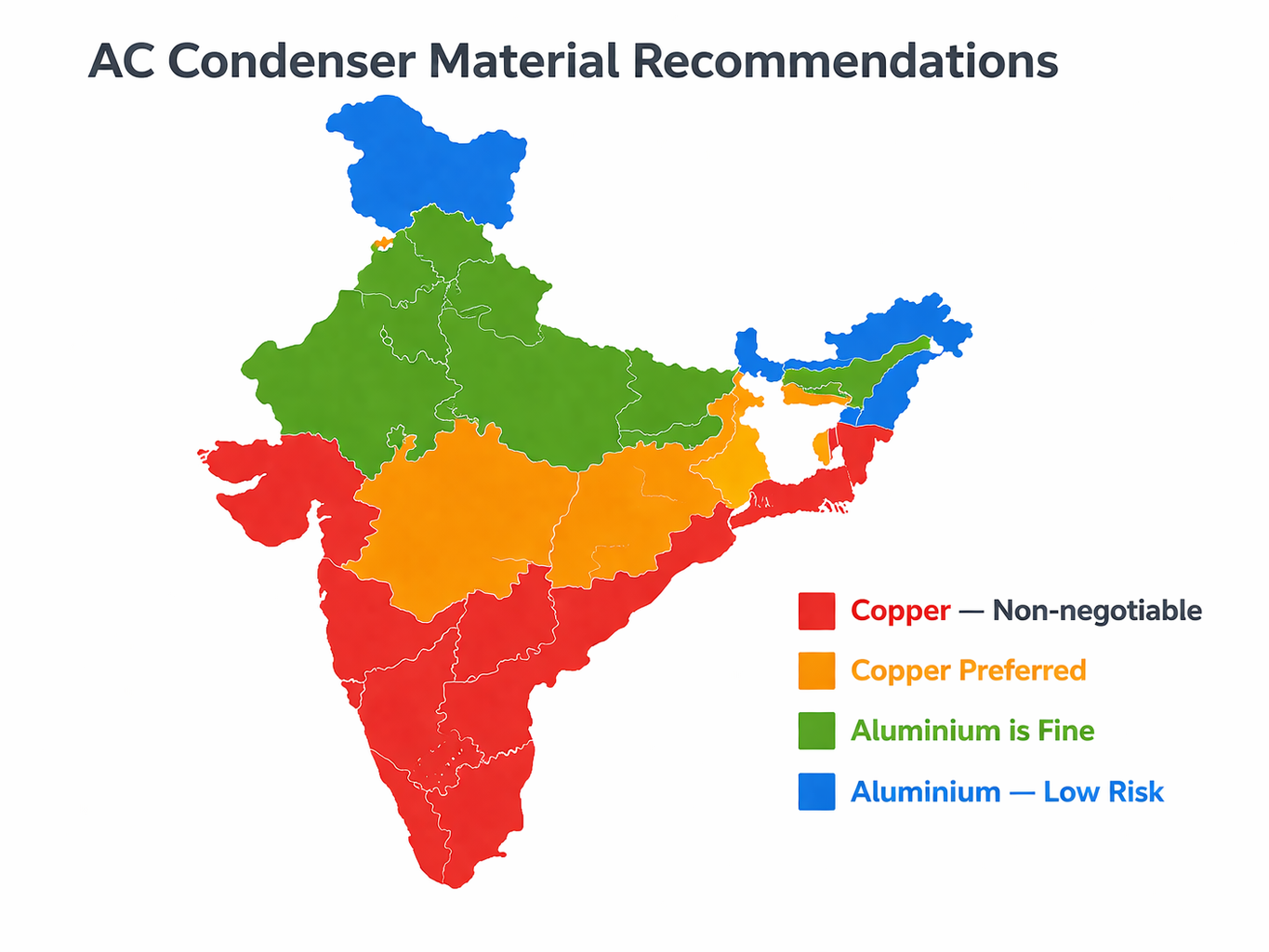
| Climate Zone | Cities | Recommendation |
|---|---|---|
| Coastal (high humidity, salt air) | Mumbai, Chennai, Kolkata, Kochi, Vizag, Goa, Mangalore | Copper — non-negotiable |
| Humid inland (60–70% humidity) | Hyderabad, Bhubaneswar, Ahmedabad (monsoon months) | Copper preferred |
| Dry inland (below 50% humidity) | Delhi, Jaipur, Nagpur, Lucknow, Chandigarh, Pune | Aluminium is fine |
| Hill stations (cool, low AC usage) | Shimla, Ooty, Bangalore (mild areas) | Aluminium — low usage, low risk |
3. Repairability — The Hidden Cost Advantage of Copper
When a copper condenser develops a leak, a local AC technician can solder it on-site for ₹1,500–3,000. The repair takes 1–2 hours, and the coil continues working for years afterward.
When an aluminium condenser develops a leak, soldering is unreliable — aluminium welding requires specialised equipment that most field technicians don't carry. In practice, a leaking aluminium condenser means a full coil replacement at ₹8,000–12,000, plus labour.
| Scenario | Copper Cost | Aluminium Cost |
|---|---|---|
| Minor leak repair | ₹1,500–3,000 (on-site solder) | ₹8,000–12,000 (full replacement) |
| Major damage | ₹5,000–8,000 (section replacement) | ₹8,000–12,000 (full replacement) |
| Availability of repair | Any local technician | Authorised service centre only |
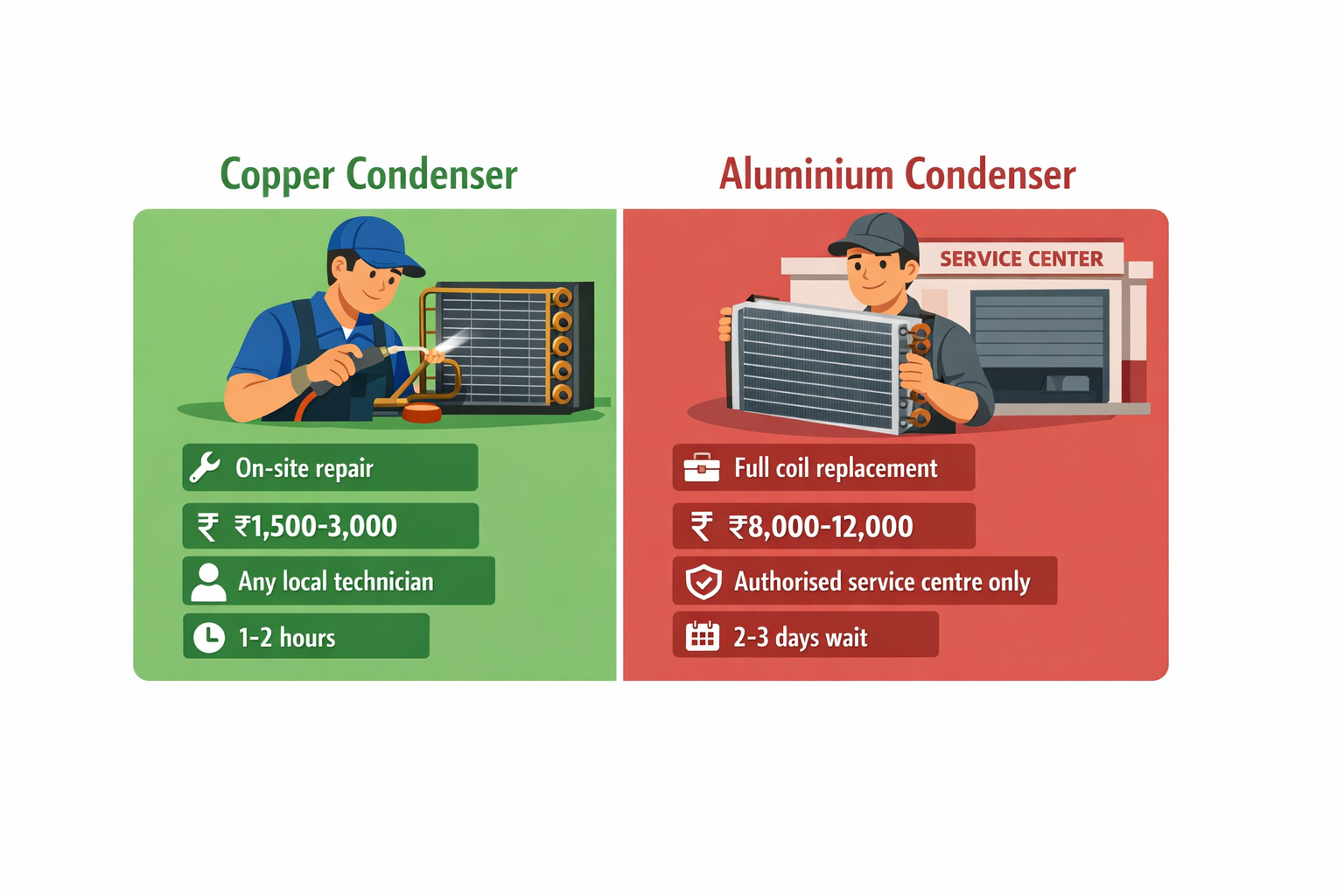
This repairability advantage matters most in tier-2 and tier-3 cities where authorised service centres may be far away. A copper condenser can be fixed by any competent AC mechanic.
4. Durability and Lifespan
Copper is mechanically stronger than aluminium. It resists physical damage from hailstorms, stray cricket balls, or the occasional bird nesting on the outdoor unit. Aluminium fins bend easily and, once bent, restrict airflow and reduce efficiency.
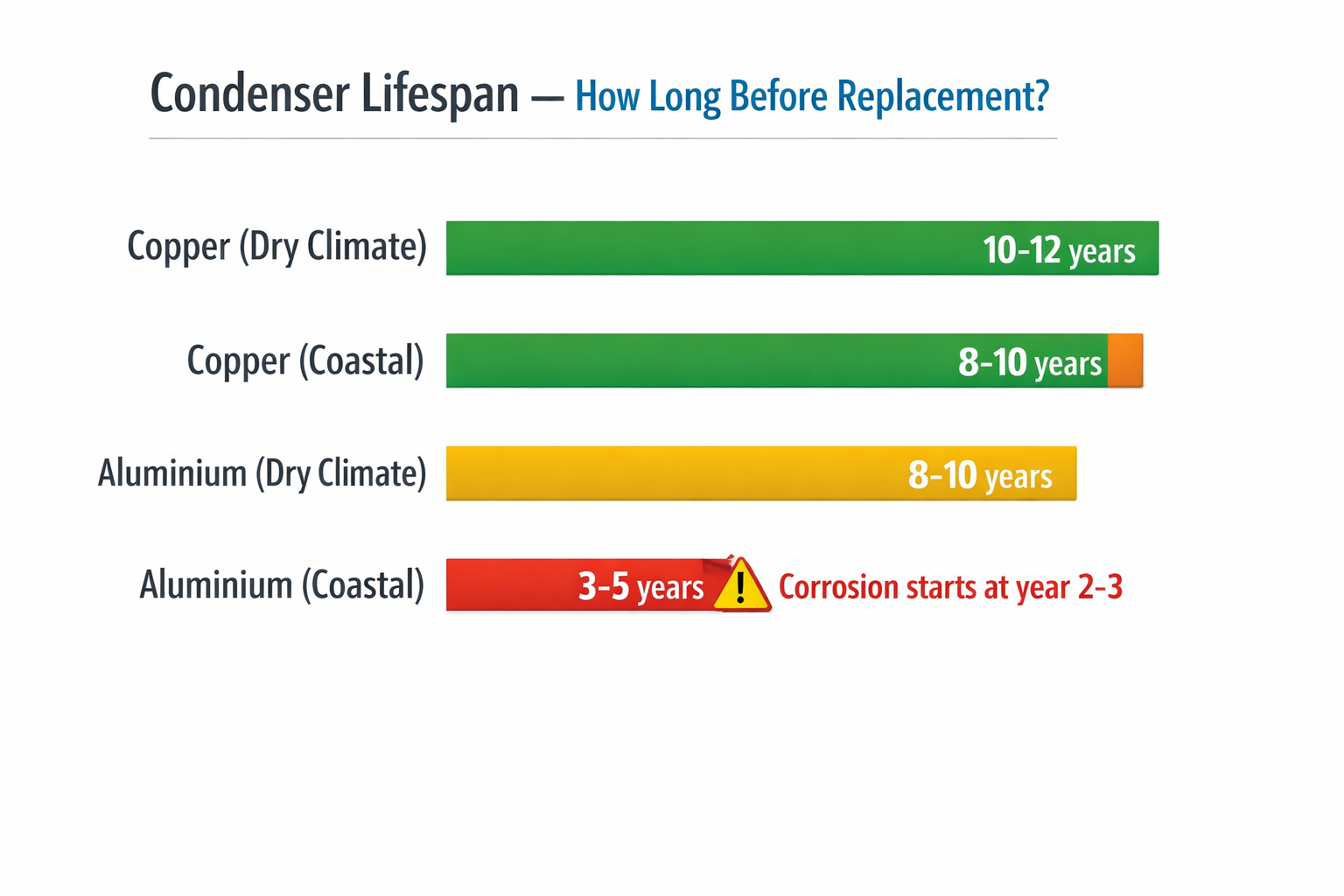
In terms of overall lifespan:
- Copper condenser (dry climate): 10–12 years with no issues
- Copper condenser (coastal): 8–10 years, may need minor repairs after year 6
- Aluminium condenser (dry climate): 8–10 years, generally fine
- Aluminium condenser (coastal): 3–5 years before significant corrosion, possible coil replacement needed
5. The "Micro Channel" and "Blue Fin" Marketing
Brands use various coatings and designs to extend aluminium condenser life:
Blue Fin coating — An anti-corrosion coating applied to aluminium fins. Adds genuine protection, extending aluminium's life by 1–2 years in humid conditions. Worth having if you're buying an aluminium condenser, but it doesn't make aluminium equal to copper in coastal areas.
Gold Fin / Hydrophilic coating — Similar to Blue Fin. Helps water slide off the fins, reducing moisture retention and corrosion. Marginal improvement.
Micro Channel condensers — Use flat aluminium tubes instead of round ones. Better heat transfer than traditional aluminium but less repairable than copper. These are increasingly common in budget models.
None of these coatings make aluminium suitable for coastal cities. They extend life from 3 years to 4–5 years, but copper still lasts 8–10 years in the same environment.
6. Price Premium — Is It Worth It?
The copper-over-aluminium premium is typically ₹2,000–4,000. Here's the value calculation:
In coastal/humid areas: The premium saves you a ₹8,000–12,000 condenser replacement that you'd likely face within 4–5 years with aluminium. Return on investment: 2–4x. Buy copper without hesitation.
In dry inland areas: Aluminium lasts nearly as long as copper (8–10 years vs 10–12 years). The repairability advantage still exists but you're less likely to need it. The premium is marginal insurance — nice to have, not essential.
Common Mistakes to Avoid
Choosing aluminium in a coastal city to save ₹3,000 — This is a false economy. The condenser will corrode within 3–4 years, and the replacement costs ₹8,000–12,000. You'll spend 3–4x what you saved. In Mumbai, Chennai, Kolkata, Kochi, or any city within 50 km of the coast, copper is not optional.
Assuming "Blue Fin" coating makes aluminium equal to copper — Blue Fin adds corrosion resistance but doesn't fundamentally change aluminium's vulnerability to salt air. It extends lifespan by 1–2 years, not 5–7. In coastal areas, it's still not enough.
Ignoring condenser material when comparing AC prices online — Online listings don't always specify condenser material prominently. Two models that look identical except for a ₹3,000 price difference may differ on copper vs aluminium. Always check the specifications before comparing prices.
Prioritising condenser material over tonnage or star rating — The condenser matters, but getting the right tonnage and star rating matters more. If your budget is tight, get the correct tonnage and a 3-star rating first. Then, if there's room in the budget, upgrade to copper. A wrong-tonnage AC with a copper condenser is worse than a right-tonnage AC with aluminium.
Find the right AC for your climate
Our comprehensive AC buying guide covers tonnage, star rating, and all the factors beyond condenser material.
Read the Full AC Buying Guide →→Frequently Asked Questions
In coastal and high-humidity areas (Mumbai, Chennai, Kolkata, Kochi, Goa), absolutely — copper's corrosion resistance saves you a ₹8,000–12,000 condenser replacement within 3–5 years. In dry inland cities (Delhi, Jaipur, Nagpur), it's a nice-to-have but not essential. Aluminium with Blue Fin coating lasts 8–10 years in dry climates.
Not easily. Aluminium soldering requires specialised equipment most local technicians don't have. In practice, a leaking aluminium condenser means full coil replacement at ₹8,000–12,000. Copper condensers can be soldered on-site by any AC technician for ₹1,500–3,000.
No. Blue Fin coating adds 1–2 years of corrosion protection, extending an aluminium condenser's life from about 3 years to 4–5 years in coastal areas. Copper lasts 8–10 years in the same conditions. Blue Fin is a worthwhile feature on aluminium condensers, but it doesn't close the gap with copper in humid environments.