AC Tonnage Calculator — What Size AC Do You Need?
Find the right AC tonnage for your room. Our calculator accounts for room size, floor level, sun exposure, and insulation — not just square footage.
Getting the tonnage right is the single most important AC decision. An undersized AC runs non-stop without cooling your room properly. An oversized AC short-cycles, leaving the room clammy and humid. Both waste electricity and shorten the compressor's life.
Most "tonnage calculators" online give you a room size chart and call it done. That's not enough — your floor level, sun exposure, ceiling height, and city all affect the tonnage you need. This guide covers all of it.
Key Decision Factors
1. The Basic Room Size Chart
Start here. This covers standard conditions: 10-foot ceiling, middle floor, average insulation, no direct afternoon sun.
| Room Size (sq ft) | Recommended Tonnage | Typical Room |
|---|---|---|
| Up to 100 | 0.8 Ton | Small study, single occupancy |
| 100–120 | 1.0 Ton | Compact bedroom, home office |
| 120–150 | 1.0–1.5 Ton | Standard bedroom |
| 150–180 | 1.5 Ton | Master bedroom, medium living room |
| 180–220 | 1.5–2.0 Ton | Large bedroom, living room |
| 220–280 | 2.0 Ton | Large living room, open-plan space |
| 280–350 | 2.0–2.5 Ton | Very large hall (may need two units) |
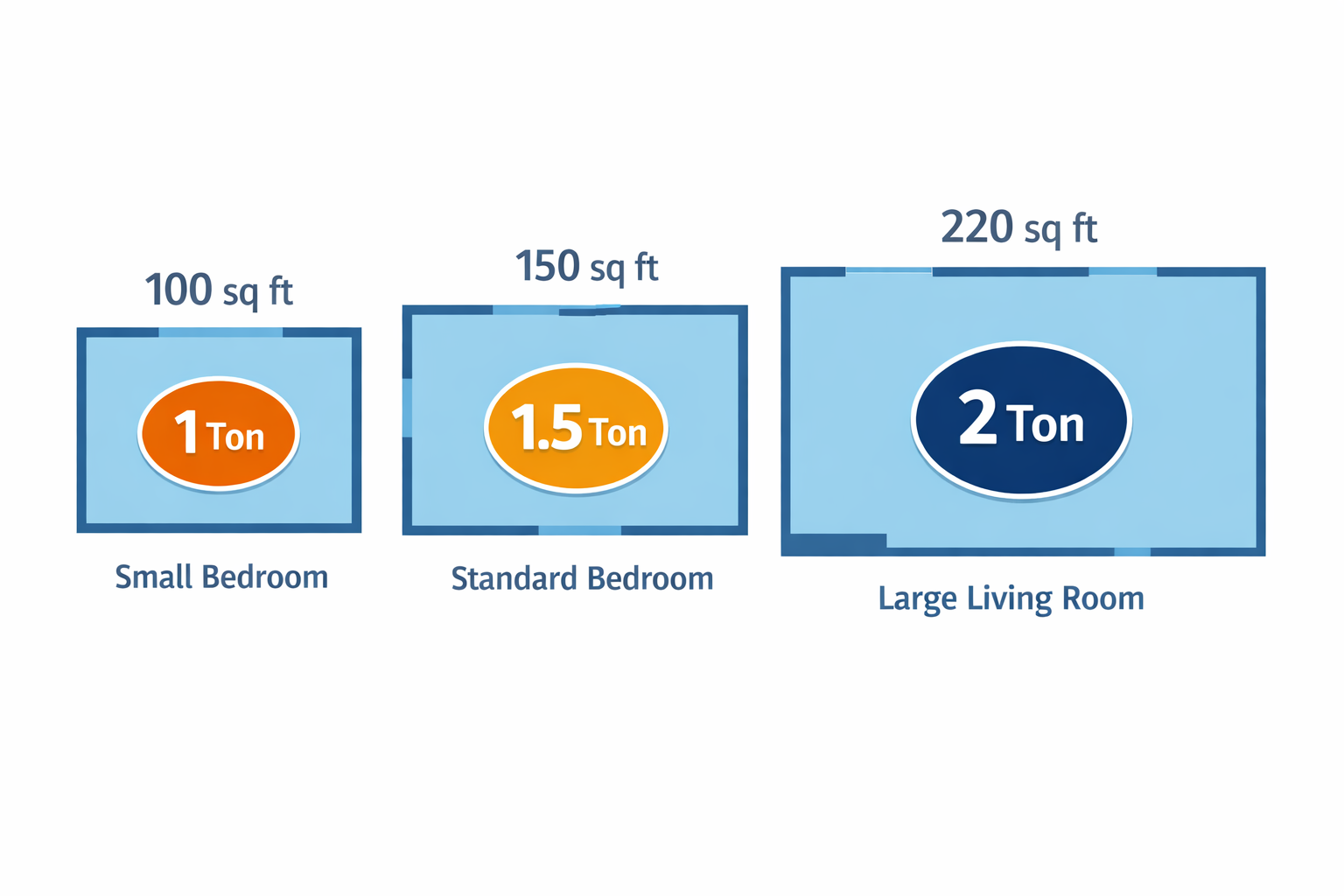
How to measure your room: Length (feet) × Width (feet) = Area (sq ft). A 12 ft × 15 ft room is 180 sq ft.
For rooms that fall between two tonnage ranges (e.g., 150 sq ft falls in the 1.0–1.5 range), use the adjustment factors below to determine whether to go higher or lower.
2. Floor Level — The Factor That Changes Everything
Heat rises. The top floor of any building absorbs direct solar radiation through the roof, adding 20–30% to the cooling load compared to middle floors. This is the most commonly underestimated factor in AC sizing.
| Floor Level | Adjustment | Why |
|---|---|---|
| Ground floor | Standard or -10% | Often shaded, cooler ground contact |
| Middle floors | Standard (no adjustment) | Insulated above and below by other floors |
| Top floor | +20–30% (size up 0.5 ton) | Direct roof heat, especially in concrete buildings |
| Top floor + no false ceiling | +30–40% (size up 0.5 ton minimum) | RCC slab radiates heat directly into the room |
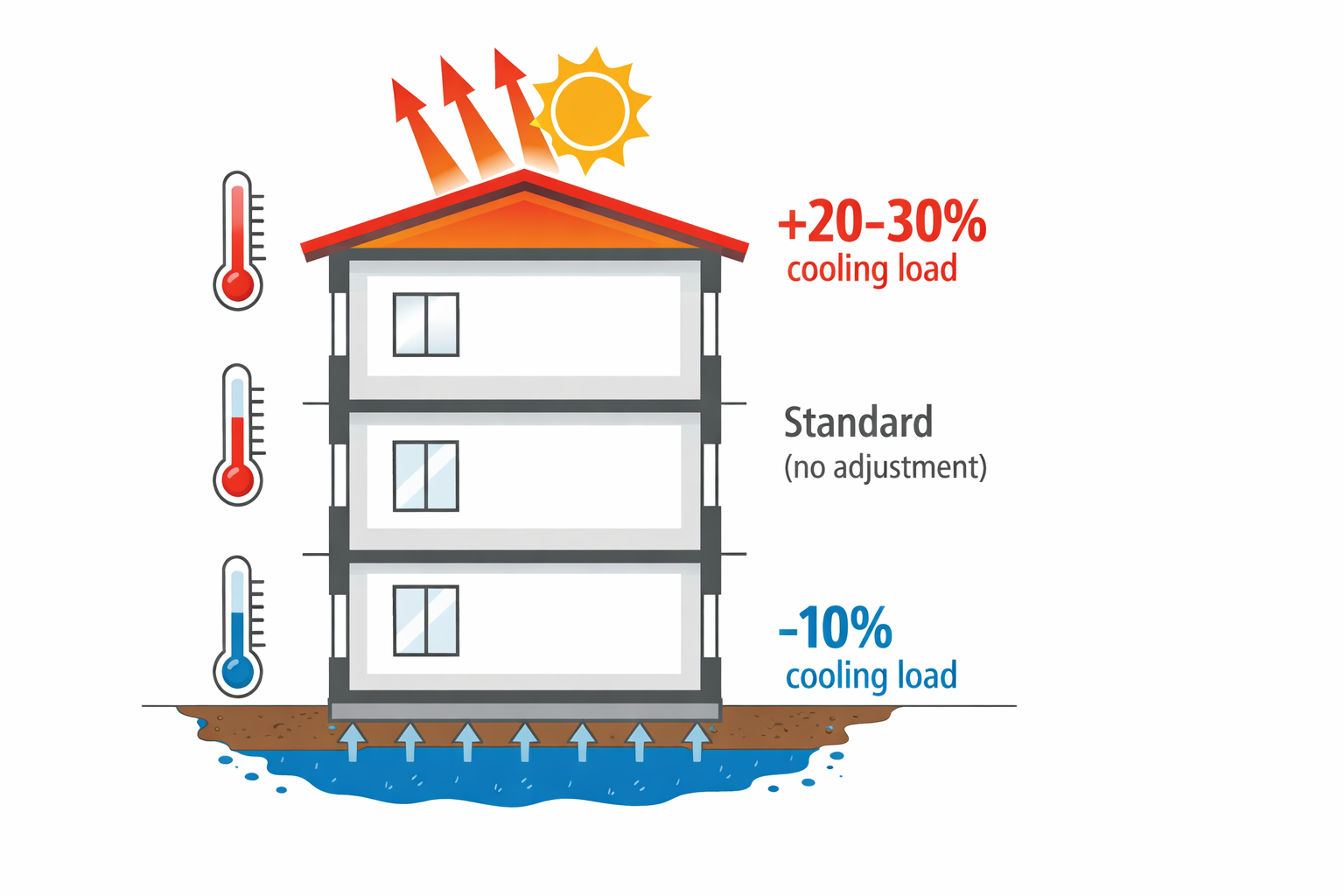
Example: A 150 sq ft top-floor bedroom would normally need 1.5 ton. But the roof heat load pushes it into 2-ton territory. If you can only find 1.5 ton models in your budget, a false ceiling (even just over the AC area) helps significantly.
3. Sun Exposure and Window Direction
Which direction your windows face determines how much solar heat enters the room during the day:
| Window Direction | Heat Impact | Adjustment |
|---|---|---|
| North-facing | Minimal direct sun | No adjustment |
| East-facing | Morning sun (cooler) | +5–10% |
| South-facing | Consistent sun throughout the day | +10–15% |
| West-facing | Intense afternoon sun (hottest) | +15–25% (size up if borderline) |
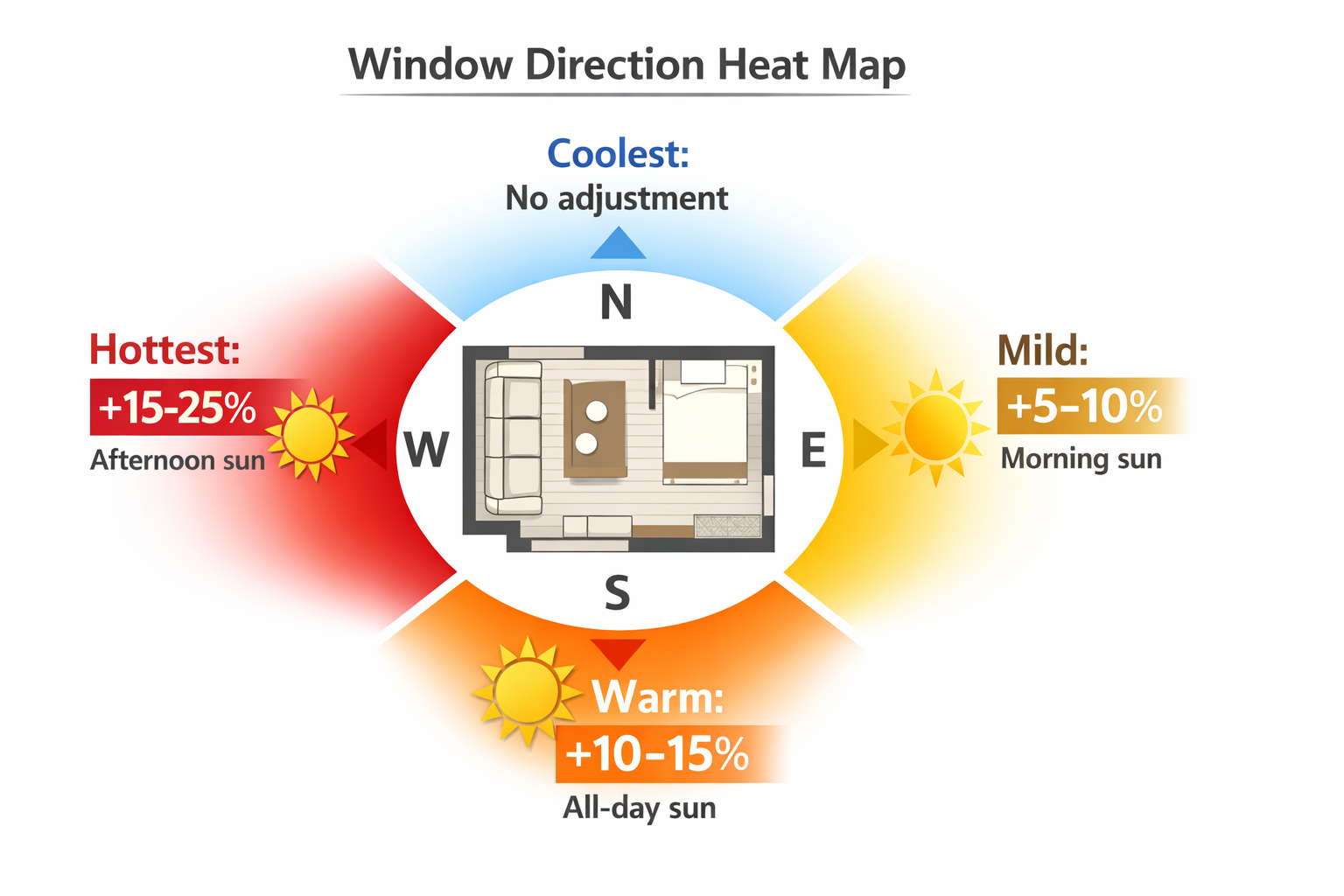
Large windows amplify the effect. A west-facing room with floor-to-ceiling glass gets significantly hotter than one with a small window. Curtains or blinds reduce the impact by 30–50%.
Multiple windows on different walls add up. A corner room with west and south windows gets hit from both directions — size up by 0.5 ton if your room is already in the upper range of its tonnage bracket.
4. Ceiling Height — Higher Ceilings Need More Power
Standard Indian apartments have 10-foot (3-metre) ceilings. The tonnage charts above assume this height. If your ceiling is different:
| Ceiling Height | Adjustment |
|---|---|
| 9 feet (older apartments) | -5% |
| 10 feet (standard) | No adjustment |
| 11–12 feet (premium apartments) | +10–15% |
| 14+ feet (bungalows, old buildings) | +20–30% (or size up 0.5 ton) |
Volume matters more than area. A 150 sq ft room with a 14-foot ceiling has 40% more air volume than the same room with a 10-foot ceiling. The AC needs to cool all that extra air.
5. Climate Zone — Where You Live Matters
India spans multiple climate zones, and the outside temperature directly affects how hard your AC works. The tonnage charts assume 35°C outside temperature. If your city regularly exceeds that:
| Climate | Cities | Adjustment |
|---|---|---|
| Extreme heat (45°C+) | Nagpur, Jaipur, Delhi (May–June), Ahmedabad | +15–20% (size up if borderline) |
| Hot (38–44°C) | Hyderabad, Lucknow, Bhopal, Pune (summer) | +5–10% |
| Moderate (32–37°C) | Mumbai, Chennai, Bangalore, Kolkata | No adjustment |
| Mild (below 32°C) | Hill stations, Northeast India | -10% or lower tonnage |
Humidity also matters. High humidity (Mumbai, Chennai, Kolkata) makes the AC work harder to dehumidify. But since these cities don't reach extreme temperatures, the humidity effect roughly cancels out the lower temperature advantage. No additional adjustment needed.
6. The Adjustment Calculator — Putting It Together
Here's how to calculate your ideal tonnage:
Step 1: Find your base tonnage from the room size chart (Factor 1)
Step 2: Add or subtract based on these factors:
| Factor | Condition | Adjustment |
|---|---|---|
| Top floor | Yes | +0.5 ton |
| West-facing large windows | Yes | +0.25 ton |
| South-facing large windows | Yes | +0.15 ton |
| High ceiling (12+ feet) | Yes | +0.25 ton |
| Extreme heat city (45°C+) | Yes | +0.25 ton |
| Well-insulated, curtained room | Yes | -0.25 ton |
| Ground floor | Yes | -0.15 ton |
| AC runs mainly at night | Yes | -0.25 ton |
Step 3: Round to the nearest available tonnage (0.8, 1.0, 1.5, 2.0)
Example calculations:
Case 1: Standard bedroom
- 150 sq ft, middle floor, east-facing window, 10-foot ceiling, Bangalore
- Base: 1.5 ton. No adjustments needed.
- Recommendation: 1.5 ton
Case 2: Top-floor master bedroom in Delhi
- 170 sq ft, top floor, west-facing window, 10-foot ceiling, Delhi (45°C summer)
- Base: 1.5 ton + 0.5 (top floor) + 0.25 (west window) + 0.25 (extreme heat) = 2.5 ton
- Recommendation: 2 ton (round down, as 2.5 ton units are rare; ensure good curtains)
Case 3: Ground-floor study room
- 100 sq ft, ground floor, north-facing, well-insulated, nighttime use only
- Base: 1.0 ton - 0.15 (ground) - 0.25 (insulated) - 0.25 (night use) = 0.35 ton reduction
- Recommendation: 0.8 ton or 1.0 ton (0.8 ton units are available from select brands)
7. When You're Between Sizes — Go Up, Not Down
If your calculation lands between 1.0 and 1.5 ton, choose 1.5 ton. If it lands between 1.5 and 2.0, choose 2 ton.
The cost of a slightly oversized inverter AC is minimal — an inverter compressor simply runs at lower speed, consuming less power. The cost of an undersized AC is constant: higher bills, poor cooling, and a shorter compressor life.
Exception: If you're between sizes and the room is well-insulated with curtains, primarily used at night, and in a moderate climate city — the lower tonnage with a 5-star rating will perform well.
Common Mistakes to Avoid
Using the builder's "carpet area" instead of actual room dimensions — Carpet area includes the area under built-in wardrobes, attached bathrooms, and balcony doors. Measure the room you're actually cooling: the open space from wall to wall, excluding areas that are walled off.
Ignoring the kitchen opening — If your living room is open to the kitchen (no door), the AC is cooling both spaces. Add the kitchen area to your room size calculation. A 200 sq ft living room connected to a 60 sq ft kitchen is effectively a 260 sq ft space.
Buying a smaller AC and "running it longer" — An undersized AC doesn't cool better with more time; it runs at full capacity without reaching target temperature. The compressor never gets to rest, electricity consumption is maximised, and the room remains uncomfortable. This is the most expensive mistake in AC buying.
Not accounting for heat-generating appliances — A room with a gaming PC (200–500W heat output), server rack, or multiple monitors generates significant heat. In home offices with substantial equipment, size up by 0.25–0.5 ton.
Know your tonnage? See our top picks
We rank the best ACs by tonnage and star rating, with detailed scoring and real-world testing.
Browse AC Recommendations →→Frequently Asked Questions
A 12×15 room is 180 sq ft, which needs a 1.5 ton AC under standard conditions (middle floor, 10-foot ceiling, no extreme sun). If it's a top-floor room, has large west-facing windows, or you're in a city that hits 45°C, size up to 2 ton.
Generally no. A 150 sq ft room needs 1.5 ton under standard conditions. A 1-ton AC would be undersized, running at full capacity without reaching your set temperature — resulting in poor cooling and high electricity bills. The only exception: a ground-floor, well-insulated room in a mild climate used primarily at night.
Yes. Standard tonnage charts assume 10-foot ceilings. Rooms with 12+ foot ceilings have 20–30% more air volume and need additional cooling capacity. For ceilings above 12 feet, size up by 0.25–0.5 ton. This is particularly common in older buildings, bungalows, and premium apartments.