Inverter vs Non-Inverter AC: Which Should You Buy in 2026?
Inverter ACs cost more upfront but save thousands on electricity. Here's the real math, the exceptions, and when a non-inverter still makes sense.
The short answer: buy inverter. In 2026, the price gap has shrunk to ₹3,000–5,000, and inverter ACs save 30–50% on electricity every single month. But if you're reading this, you probably want the full picture — the actual numbers, the edge cases, and why non-inverter models still exist at all.
Key Decision Factors
1. How Inverter Technology Actually Works
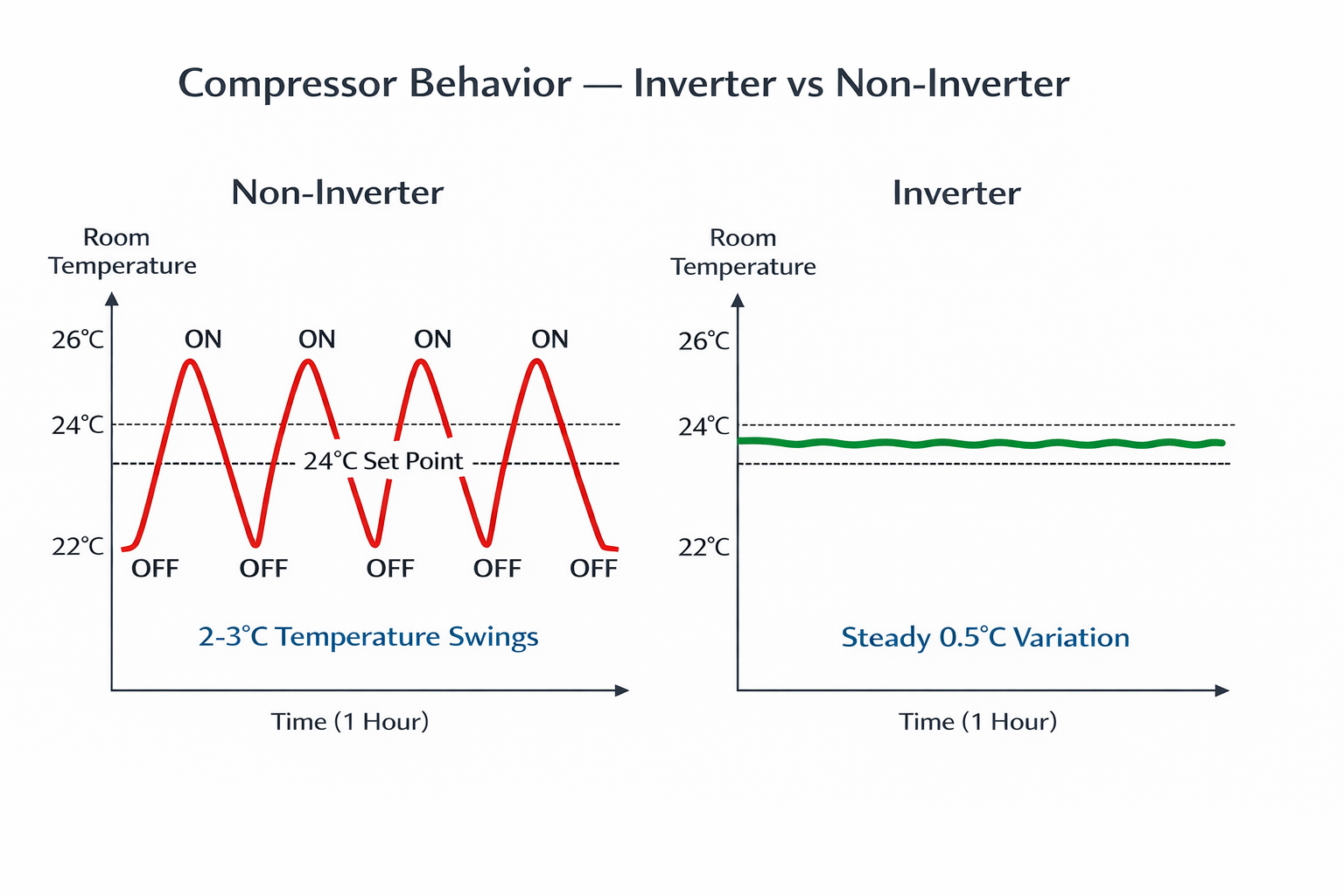
A non-inverter (fixed-speed) AC has a compressor with two states: full power and off. When your room hits the set temperature, the compressor shuts off completely. When the temperature rises 2–3°C above your setting, it kicks back on at full blast. This constant cycling is why you feel alternating waves of cold and warm air.
An inverter AC's compressor runs continuously but adjusts its speed. When the room is far from your set temperature, it runs at maximum capacity. As the room approaches the target, it slows down — sometimes running at just 20–30% of its rated power. The compressor never fully stops, maintaining a steady temperature within 0.5°C of your setting.
This isn't a gimmick. It's a fundamental engineering difference that affects every aspect of the AC's performance.
2. The Electricity Math — Real Numbers, Not Marketing Claims
Here's what the monthly electricity bill looks like for a 1.5 ton AC running 8 hours per day at ₹8/unit (average Indian domestic rate):
| Parameter | Inverter (5-star) | Non-Inverter (3-star) |
|---|---|---|
| Average power draw | 0.8–1.0 kW | 1.4–1.7 kW |
| Monthly consumption (8 hrs/day) | 192–240 units | 336–408 units |
| Monthly bill (₹8/unit) | ₹1,536–1,920 | ₹2,688–3,264 |
| Annual cost (5 months use) | ₹7,680–9,600 | ₹13,440–16,320 |
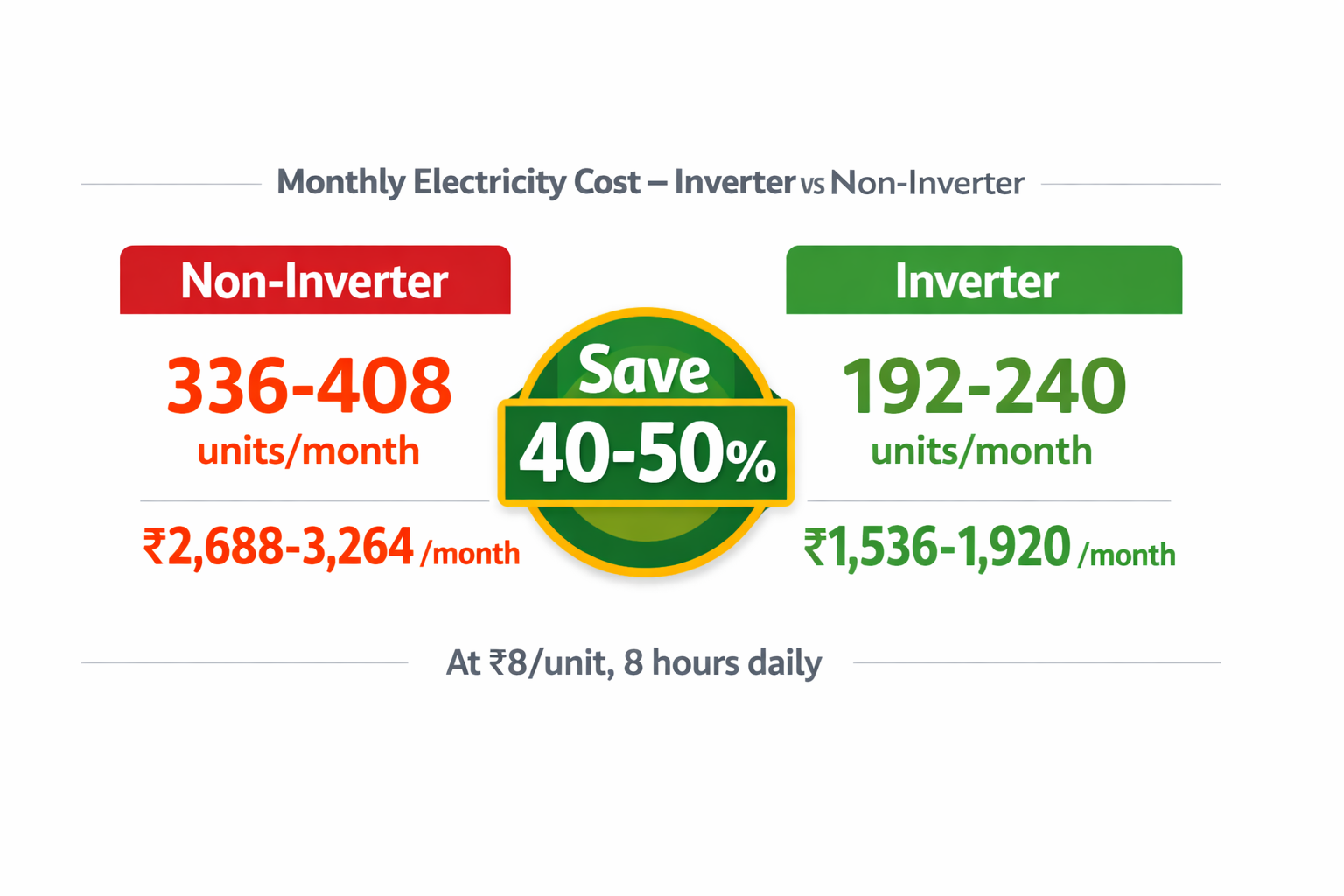
The difference: ₹5,000–7,000 per year. Over the AC's 8–10 year lifespan, that's ₹40,000–70,000 in electricity savings — against an upfront premium of just ₹3,000–5,000.
The maths isn't even close. At typical Indian usage levels, an inverter AC pays for its premium within the first summer.
3. Noise — The Difference You'll Notice Every Night
A non-inverter compressor starting up produces a distinct thump followed by a hum at 48–52 dB. When it shuts off, there's another noticeable click. This cycle repeats every 15–20 minutes throughout the night.
An inverter compressor running at low speed produces 24–32 dB — quieter than a library. Since it never fully stops, there are no startling on/off sounds.
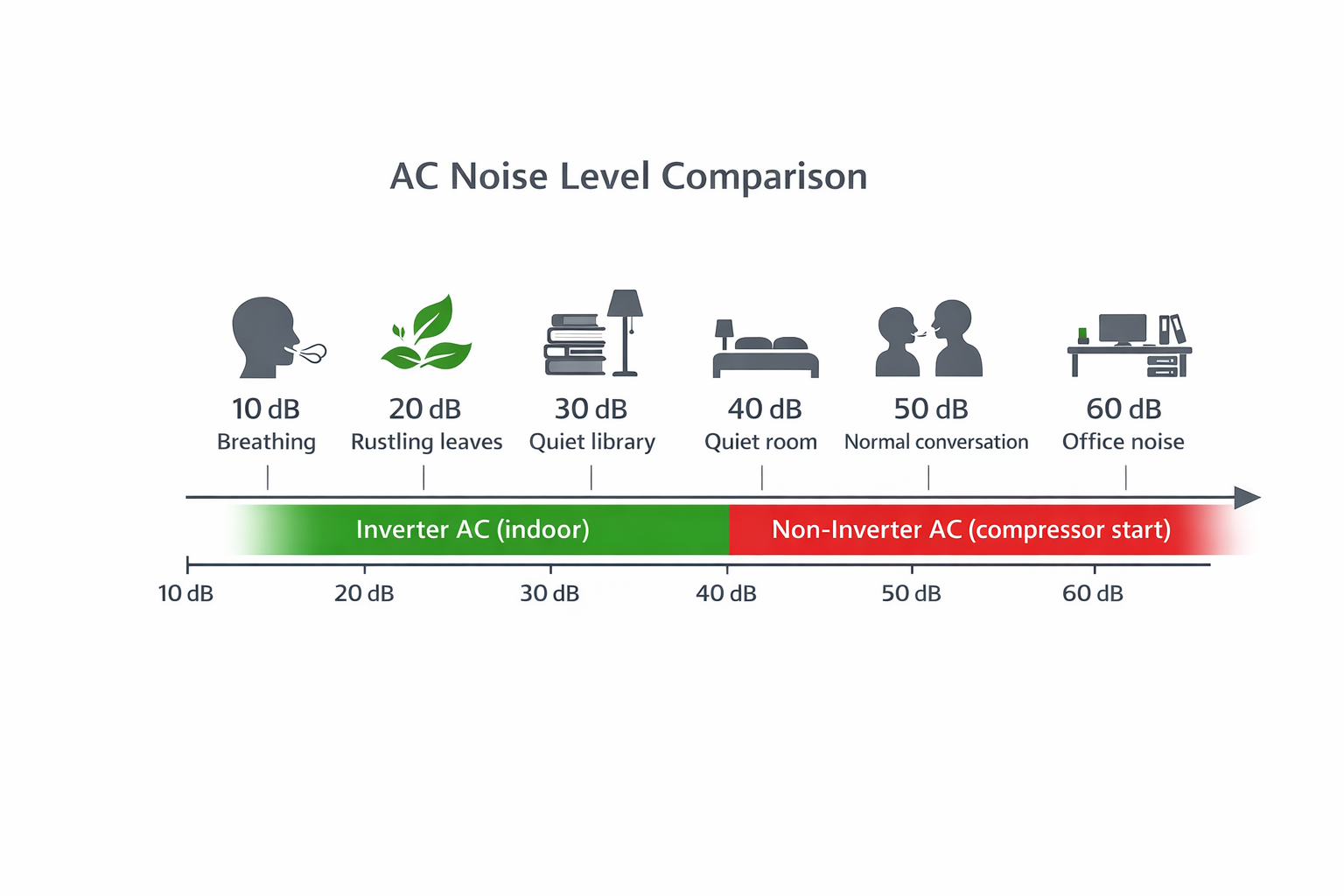
If this AC is going in a bedroom, the noise difference alone justifies the inverter premium. Light sleepers will notice the difference immediately.
4. Compressor Longevity — Why Inverter ACs Last Longer
Every time a non-inverter compressor starts from a dead stop, it experiences a power surge of 3–5x its running current. This "inrush current" stresses the motor windings and starting components. Over thousands of cycles, this wear accumulates.
An inverter compressor starts gently and rarely shuts off completely. There's no inrush current, no thermal shock from repeated heating and cooling of components. This is why most manufacturers offer 10-year compressor warranties on inverter models versus 5 years on non-inverter.
Practically speaking: inverter ACs typically last 10–12 years with proper maintenance. Non-inverter models often develop compressor issues by year 6–8.
5. Cooling Speed and Comfort
Here's a point that isn't discussed enough: an inverter AC cools your room faster than a non-inverter of the same tonnage.
When you first turn it on, an inverter compressor runs at 110–120% of its rated capacity (called "boost mode" or "turbo mode"). A 1.5 ton inverter AC can deliver 1.7–1.8 tons of cooling for the first 15–20 minutes, bringing your room to temperature faster. A 1.5 ton non-inverter always runs at exactly 1.5 tons — no more.
After the initial cooldown, the inverter settles into low-speed mode, maintaining temperature precisely without the 2–3°C swings of a fixed-speed unit.
6. When a Non-Inverter Still Makes Sense
There are exactly two scenarios where a non-inverter AC is a defensible choice:
Budget window ACs for rentals — If you're in a rental, need a window AC, and your total budget is under ₹20,000, a non-inverter window AC might be your only option. Even here, check if an inverter window model is within ₹2,000–3,000 of your budget — the savings will repay that gap within months.
Temporary or very occasional use — A guest room that runs the AC 10–15 days a year, or a shop that needs cooling for 2–3 hours daily during peak summer. At under 100 hours of annual use, the electricity savings won't cover the premium within a reasonable timeframe.
In every other scenario — bedrooms, living rooms, offices, any space used regularly — inverter is the clear choice.
Common Mistakes to Avoid
Comparing sticker prices without considering electricity costs — A ₹28,000 non-inverter looks cheaper than a ₹33,000 inverter. But add ₹5,000–7,000 in extra electricity per year, and the non-inverter is the more expensive option by the end of the first summer. Always compare the 3-year total cost of ownership.
Thinking "inverter" means "5-star" — These are independent specifications. You can buy a 3-star inverter AC (decent efficiency, moderate price) or a 5-star inverter AC (maximum efficiency, higher price). The inverter/non-inverter distinction is about the compressor type. The star rating is about how efficiently that compressor converts electricity into cooling.
Oversizing tonnage to compensate for a non-inverter — "I'll buy a 2-ton non-inverter instead of a 1.5-ton inverter for my 150 sq ft room." This makes the short-cycling problem worse — the oversized unit cools too fast, shuts off, and restarts constantly. Match tonnage to room size regardless of compressor type.
Ignoring the voltage stabiliser requirement — Non-inverter ACs are more sensitive to voltage fluctuations because the compressor starts at full power. In areas with unstable power supply, a voltage stabiliser (₹1,500–3,000) is essential for non-inverter models. Most inverter ACs operate safely across 150V–260V without a stabiliser.
Ready to see our top picks?
We rank the best 1.5 ton split ACs — all inverter — based on real-world performance testing.
View Best 1.5 Ton ACs →→Frequently Asked Questions
Yes. The price gap has narrowed to ₹3,000–5,000, while the electricity savings are ₹5,000–7,000 per year at typical usage (8 hours/day, 5 months). An inverter AC pays for its premium within the first summer and saves ₹40,000–70,000 over its lifespan. It also runs quieter, maintains more consistent temperature, and lasts longer.
Most inverter ACs have a built-in wide voltage range of 150V–260V, so they handle fluctuations without a stabiliser. Non-inverter ACs are more sensitive and typically need one. If your area experiences voltage drops below 150V, you'll need a stabiliser regardless of AC type.
No. Maintenance is identical — filter cleaning every 2 weeks, professional servicing once a year before summer. Inverter ACs actually tend to need fewer repairs because the compressor experiences less wear from constant start-stop cycles.