Badminton Racket Buying Guide India — Weight, Balance, and What Actually Matters
How to choose the right badminton racket for your skill level and play style. Weight classes, balance points, shaft flex, materials, and the mistakes that waste your money.
Every badminton racket boils down to three variables: weight, balance point, and shaft flexibility. Get these three right for your skill level and play style, and you'll play better with a ₹1,500 racket than someone with the wrong ₹8,000 one. Everything else — frame shape, grommet system, cosmetic technology names — is secondary. Brands spend enormous marketing budgets convincing you that their proprietary nano-mesh-aero-carbon technology is revolutionary. It's not. It's incremental refinement on top of the three fundamentals.
This guide covers what specs to look for and why they matter. Once you know what you need, head to our tested rankings for specific product picks at every budget.
The Three Variables That Define Your Racket
Weight Classes — What the Numbers Mean
Badminton rackets use a "U" system for weight — the higher the U number, the lighter the racket. This is counterintuitive, and it trips up every first-time buyer. Here's what each class actually means in practice:
| Weight Class | Weight Range | Best For | Example Racket |
|---|---|---|---|
| 2U | 90–94g | Power hitters with strong technique | Yonex Voltric Z-Force II |
| 3U | 85–89g | Aggressive singles players | Li-Ning Axforce 80 |
| 4U | 80–84g | Most competitive players, versatile | Yonex Astrox 99, Victor Thruster K |
| 5U | 75–79g | Doubles, defensive play, quick reactions | Yonex Nanoflare 700 |
5U (75–79g) rackets are ultralight. They give you the fastest swing speed and the quickest net reactions. The trade-off is power — less mass means less momentum on contact. These are excellent for doubles players who need rapid exchanges at the net, and for defensive players who prioritise returns over kills. The Yonex Nanoflare series lives here.
4U (80–84g) is the standard competitive weight. Most tournament-level rackets from Yonex, Li-Ning, and Victor come in 4U. It's the sweet spot between swing speed and power — you don't sacrifice much of either. If you're unsure, 4U is almost always the right choice.
3U (85–89g) adds stability and power. The extra mass means your smashes carry more force, and the racket doesn't twist as easily on off-centre hits. But it's slower to recover between shots. Best for strong players with good footwork who can afford the extra milliseconds.
2U (90–94g) is rare in modern rackets and mostly found in older power-focused designs. Unless you have genuinely strong arms and play a pure attacking style, avoid these.
Balance Point — Head-Heavy vs Head-Light vs Even
The balance point tells you where the racket's weight is concentrated. This single spec determines whether your racket is built for smashing, defending, or doing a bit of both. It's measured in millimetres from the handle end.
Head-heavy (balance point above 295mm): More mass sits in the racket head. This means more momentum when you swing — your smashes hit harder, your clears go deeper. The downside is slower recovery. After a big swing, it takes longer to bring the racket back to neutral. Head-heavy rackets are the weapon of choice for attacking players who live for the kill shot. The Yonex Astrox series and Li-Ning Axforce line are head-heavy favourites. If you play aggressive singles and your game revolves around setting up and executing smashes, this is your category.
Head-light (balance point below 285mm): Weight shifts toward the handle, making the racket feel faster and more manoeuvrable. You can react to drives and net shots quicker. Defence becomes easier — blocking smashes and returning tight net shots feels effortless compared to swinging a head-heavy frame. The trade-off: your smashes lack the raw power of a head-heavy racket. Perfect for defensive and doubles play where speed at the net matters more than power from the back. The Yonex Nanoflare series is the benchmark here.
Even balance (285–295mm): The compromise — and often the smartest choice. Even-balanced rackets don't excel at anything, but they don't hold you back either. They give you enough power for decent smashes and enough speed for competent net play. These are ideal for beginners and all-round players who haven't locked into a specific play style yet. The Yonex Arcsaber series is the classic even-balance line.
Shaft Flexibility — Stiff vs Flexible
The shaft is the thin section connecting the handle to the racket head. Its flexibility determines how the racket transfers your swing energy to the shuttle. This is the spec most beginners get wrong — they buy stiff because "stiff means powerful," and then wonder why their shots lack pace.
Stiff shafts don't bend much on impact. They transfer energy directly and accurately, giving you precise control over shuttle placement. But here's the catch: you have to generate all the power through correct wrist action and swing technique. A stiff shaft in the hands of a beginner just results in weak, mis-timed shots. In the hands of an advanced player, it's a precision instrument. Rackets like the Yonex Astrox 99 Pro use stiff shafts for this reason.
Medium-flex shafts bend slightly, adding a small whip effect that helps generate power even when your technique isn't perfect. They're forgiving enough for developing players while still responsive enough for competitive play. This is the ideal range for intermediate players who play 2–3 times a week and are still refining their stroke mechanics.
Flexible shafts bend noticeably on impact, storing energy and snapping back to propel the shuttle. The racket does a significant portion of the work for you — it compensates for less-than-perfect timing and wrist action. This makes flexible shafts the best choice for beginners. You get satisfying power and distance even while learning proper form.
The progression rule: Start with flexible. Move to medium after 6–12 months of regular play (2+ times per week). Only go stiff when your technique is genuinely solid — meaning you can consistently generate power from your wrist and forearm, not just your shoulder. Most recreational players never actually need a stiff shaft, and that's perfectly fine.
Materials — What You're Actually Paying For
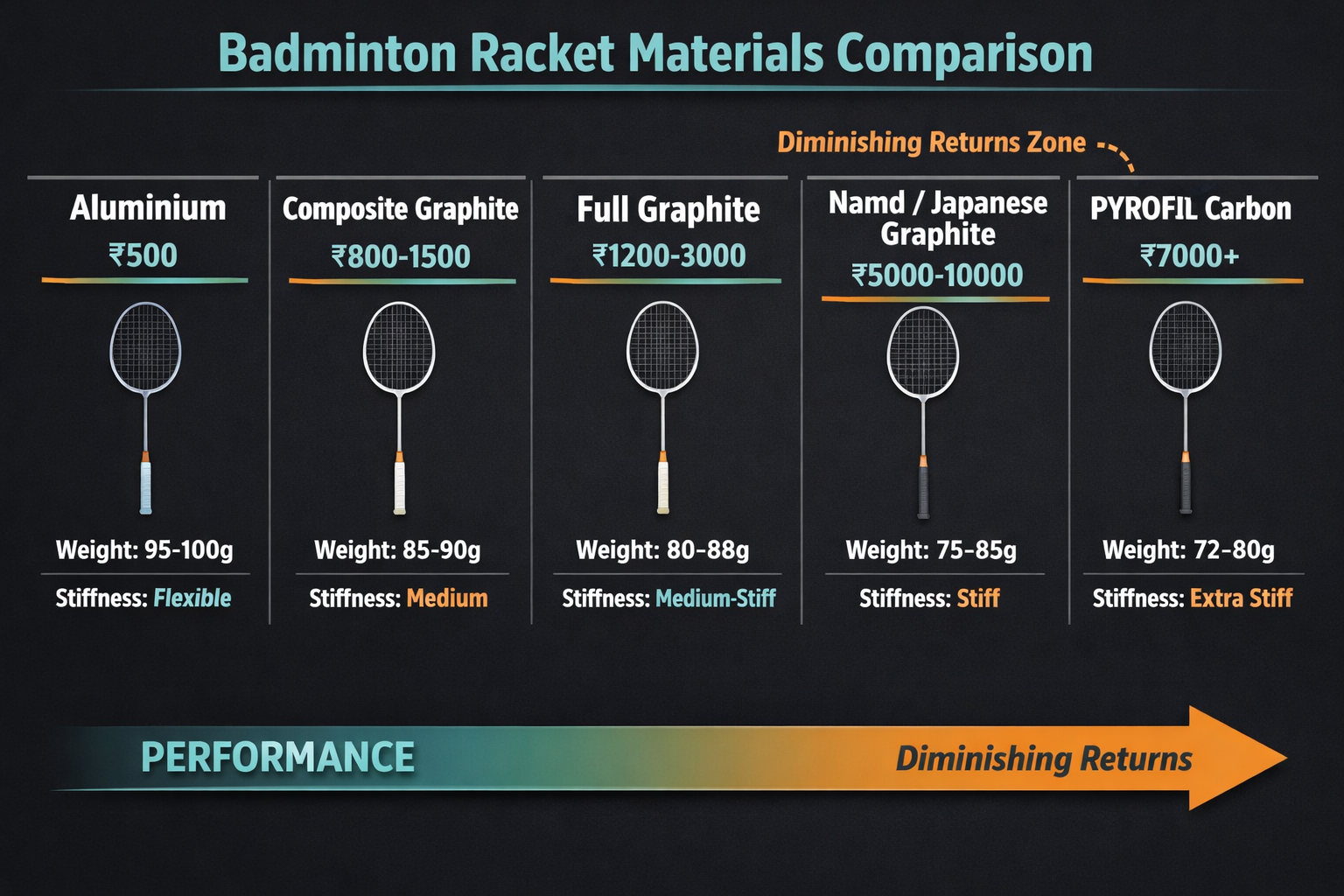
The frame and shaft material is the biggest factor in a racket's price. Here's what each tier actually delivers — and where the diminishing returns kick in hard.
Aluminium (under ₹500): Heavy, dead-feeling frames with minimal power transfer. The shuttle goes where it goes, and you have limited control. These are the rackets bundled with ₹300 "badminton sets" on Amazon. Fine for hitting a shuttle around in your building compound. Not suitable for any level of serious play. You'll outgrow one within a week if you're actually trying to learn.
Composite graphite (₹800–1,500): A mix of graphite and other materials (sometimes aluminium in the T-joint area). Noticeably lighter and more responsive than aluminium. Brands like Yonex (GR series), Li-Ning (Wind series), and Victor offer solid options here. This is the real entry point for anyone who wants to play properly. The Yonex GR 303 at around ₹800 is a reliable example — it won't excite you, but it won't hold you back as a beginner.
Full graphite (₹1,200–3,000): The standard material for competitive rackets. Full graphite frames are light, stiff enough for good power transfer, and responsive enough to feel the shuttle on the string bed. Most club-level players use rackets in this range. The Yonex Astrox Lite series, Li-Ning Windstorm, and Victor Brave Sword models are good examples. This is where the price-to-performance ratio peaks — you get 80% of the performance of a ₹10,000 racket at a fraction of the cost.
Japanese graphite / Namd (₹5,000–10,000): Premium-grade graphite with higher modulus (stiffness-to-weight ratio). Yonex's Namd technology uses a graphite that flexes and snaps back faster than standard graphite, giving better shuttle hold on drop shots and more explosive power on smashes. At this price, you're paying for measurably better feel, faster snapback, and more precise shuttle placement. Rackets like the Yonex Astrox 88D Pro and Li-Ning Halbertec 9000 sit here. The improvement over full graphite is real but not dramatic — maybe 10–15% better in feel and responsiveness.
PYROFIL carbon / Military-grade carbon (₹7,000+): Tournament-grade materials used in top-tier rackets. PYROFIL (by Mitsubishi Chemical) offers the highest stiffness and lightest weight available. These rackets maximize power transfer and minimize energy loss. The Yonex Astrox 99 Pro, Li-Ning Axforce 100, and Victor Auraspeed 100X use these materials. But here's the honest truth: the difference between a ₹7,000 racket and a ₹15,000 racket is marginal. You're paying for the last 5% of performance. Unless you're competing at district level or above, you won't extract the full benefit.
Strung vs Unstrung — Which Should You Buy?
This is a decision most first-time buyers don't even know they need to make. Many rackets, especially above ₹3,000, are sold unstrung — just the frame, no strings. Here's when each option makes sense.
Pre-strung rackets come ready to play with factory strings installed at a standard tension (usually 20–22 lbs). The strings are basic — typically a durable but unremarkable nylon multifilament. They'll last a few months and play fine for beginners and recreational use. The convenience factor is real: buy, unpack, play. Every racket under ₹2,000 is pre-strung, and many up to ₹5,000 are available in strung versions. If you play 1–2 times a week for fun and aren't competing, pre-strung is the pragmatic choice.
Unstrung rackets give you control over string type and tension — two variables that significantly affect how the racket plays. Custom stringing adds ₹300–1,000 depending on the string (Yonex BG65 is around ₹350, BG80 Power is around ₹700, Aerobite is around ₹900). You'll also need a reliable stringer — most sports shops in metro cities offer stringing services, or you can order online and have it strung locally. If you play competitively or more than 2–3 times a week, unstrung is the way to go.
String tension guide:
| Tension | Player Level | What It Does |
|---|---|---|
| 20–22 lbs | Absolute beginner | Maximum trampoline effect, easy power, large sweet spot |
| 22–24 lbs | Beginner to intermediate | Good balance of power and control |
| 25–27 lbs | Intermediate to advanced | More control, less power, smaller sweet spot |
| 28–30 lbs | Advanced to professional | Maximum control, requires excellent technique for power |
| 30–32 lbs | Professional | Extreme precision, minimal margin for error |
Higher tension gives more control but demands better technique — the sweet spot shrinks and off-centre hits punish you more. Don't string above 26 lbs unless your stringer confirms the frame can handle it and your technique justifies it. Over-tensioning cheap rackets causes frame cracks.
When to restring: A useful rule of thumb — restring as many times per year as you play per week. Play three times a week? Restring three times a year. If your strings start feeling "dead" (less repulsion, mushy feel), it's time regardless of the schedule.
How Much Should You Spend?
The honest answer: less than you think. The ₹1,500–3,000 range delivers excellent rackets for 90% of players. Here's a realistic breakdown:
| Budget | What You Get | Best For |
|---|---|---|
| Under ₹2,000 | Full graphite, pre-strung, choice of head-heavy/light/even | Beginners, recreational play 1–2x/week |
| ₹2,000–5,000 | Advanced frame tech (Nanomesh, Aerotec), higher tension tolerance, better shaft materials | Club players, competitive 2–3x/week |
| ₹5,000–10,000 | Namd graphite, PYROFIL carbon, tournament-grade construction | Competitive 3+ times/week, local tournaments |
| ₹10,000+ | Pro-level materials, tournament-grade rackets, top-tier string compatibility | District/state level, serious tournament play |
The value cliff: The biggest jump in quality happens between ₹500 and ₹1,500 — from aluminium to graphite. The second biggest jump is between ₹1,500 and ₹3,000 — from basic graphite to well-engineered graphite with proper weight distribution and shaft tuning. After ₹5,000, improvements become incremental. After ₹10,000, they're nearly imperceptible to anyone below district level.
Don't buy two cheap rackets instead of one good one. A single ₹2,500 racket will serve you far better than two ₹1,200 rackets. The second racket can be a ₹500 backup for when friends visit.
Common Mistakes
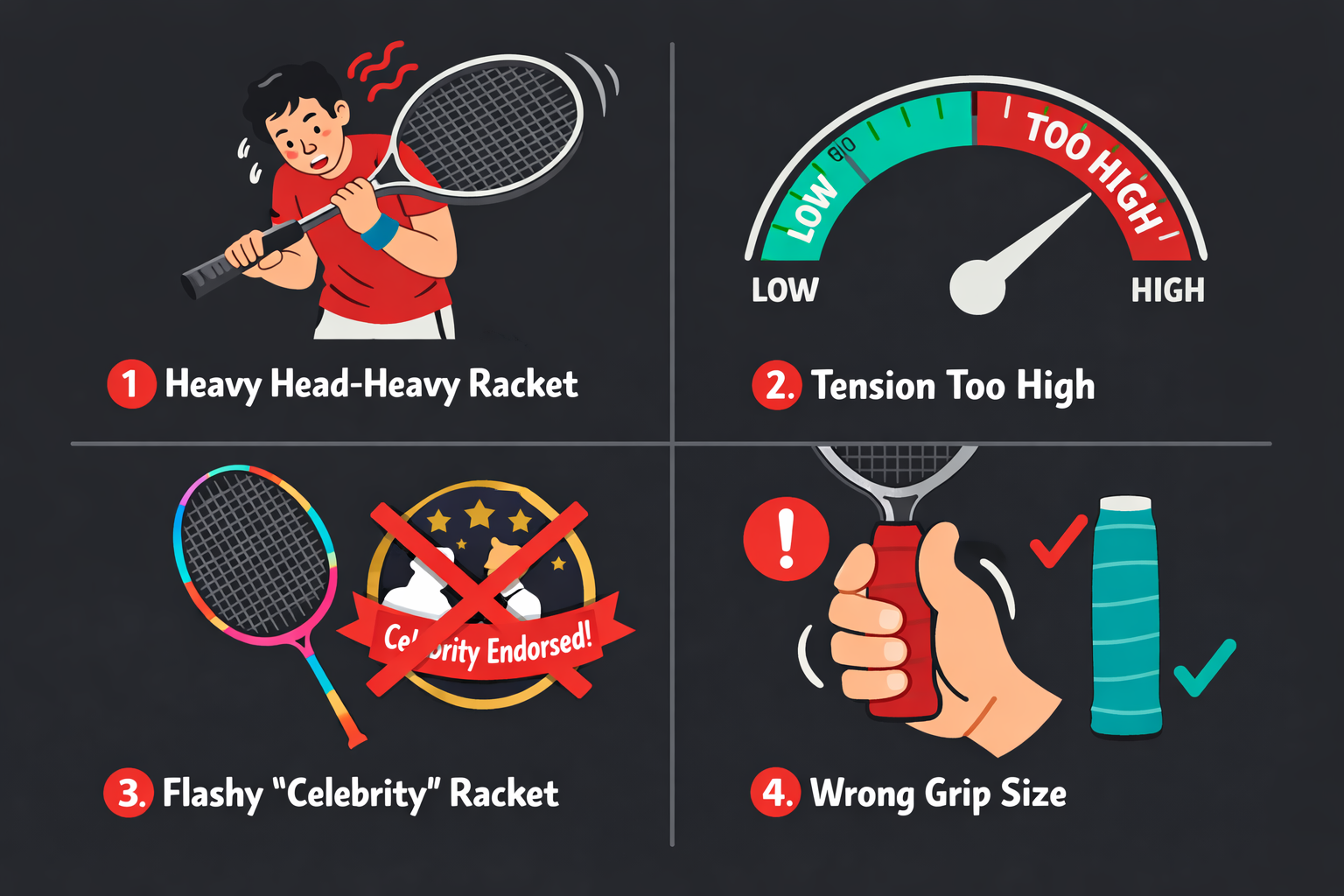
Buying a stiff, head-heavy racket as a beginner. This is the most common mistake, and it's driven by aspirational buying — "I'll grow into it." You won't. A stiff, head-heavy racket requires technique you don't have yet. It'll make learning harder, your shots weaker, and your arm sorer. Start with a flexible or medium shaft and even balance. Upgrade once your technique earns it.
Choosing 3U weight when 4U or 5U would suit your play style. Heavier doesn't mean better. If you play doubles primarily, or if you value quick net exchanges over raw smash power, a lighter racket will genuinely improve your game. Most people who switch from 3U to 4U or 5U report feeling faster within their first session.
Ignoring string tension — or going too high. Many players string at 28+ lbs because they heard professionals play at 30+. But professionals have world-class timing and technique. At high tension, the sweet spot shrinks dramatically, and off-centre hits feel terrible. For most recreational and club players, 22–25 lbs delivers better consistency and more enjoyable play. Higher tension also puts more stress on the frame — budget rackets can crack at tensions they're not rated for.
Paying a brand premium when a lesser-known brand offers the same specs. Yonex dominates Indian badminton, and they make excellent rackets. But Li-Ning, Victor, Apacs, and Ashaway make equally good rackets at competitive prices. A Li-Ning Wind Lite at ₹1,800 competes directly with Yonex options at ₹2,500+. Don't let brand loyalty override a spec-for-spec comparison. Check the weight class, balance point, shaft flex, and material — if they match your needs, the name on the frame matters far less than you think.
Key Takeaways
- Weight, balance, and shaft flex are the three decisions that matter. Get these right for your skill level and play style, and everything else falls into place.
- Start flexible and even-balanced. Move to stiffer and more specialised rackets only as your technique develops. Most club players do well with medium flex and even balance indefinitely.
- 4U is the safe weight class. Unless you have a specific reason to go lighter (doubles, defence) or heavier (pure power, strong build), 4U suits most players.
- Spend ₹1,500–3,000 for your first serious racket. This range gives you full graphite, proper engineering, and multiple balance options. Going cheaper gets you aluminium; going higher gives diminishing returns.
- Custom stringing matters more than frame price above ₹3,000. A ₹3,000 racket with the right strings at the right tension will outperform a ₹7,000 racket with factory strings for most players.
Ready to pick a racket?
We rank the best badminton rackets across budgets and play styles, with detailed scoring on weight, balance, and real-world performance.
See Our Top Picks →→Frequently Asked Questions
Neither is objectively better. Yonex has the deeper product range in India and dominates at the recreational level with reliable options like the Astrox Lite and Nanoflare series. Li-Ning has closed the gap significantly — their Axforce and Halbertec lines are tournament-grade and often priced 10-15% lower than equivalent Yonex models. Victor is the third serious contender, especially in the ₹3,000-7,000 range. Compare specs (weight, balance, flex), not logos.
For doubles, prioritise a head-light or even-balance racket in 4U or 5U weight. Doubles demands fast reactions at the net and quick drive exchanges — you need a racket that moves fast, not one that hits hard. The Yonex Nanoflare 700 (5U, head-light) and Victor Brave Sword 12 (4U, even) are popular doubles choices. Avoid head-heavy 3U rackets in doubles — they're too slow for the pace of play.
Grip size is measured as G1 through G6, with G4 and G5 being the most common in India. G4 (3.5 inches circumference) suits larger hands, G5 (3.25 inches) suits medium to smaller hands. A simple test: hold the racket in your playing hand — you should be able to fit your other hand's index finger in the gap between your fingertips and palm. If there's no gap, the grip is too thick. If there's too much space, it's too thin. You can always build up a thin grip with overgrip tape, but you can't reduce a thick grip.
Both work, but for different reasons. Sports shops let you hold the racket, feel the weight and balance, and check grip size — invaluable for your first purchase. Prices are 5-15% higher than online. Online (Amazon, Flipkart, brand websites) offers better prices and wider selection, especially for specific models in specific weight classes. Our recommendation: visit a shop to determine your preferred weight and grip size, then buy online for the best price. Always buy from authorised sellers — counterfeit rackets are common on marketplace platforms.
A quality graphite racket lasts 2-5 years with regular play (3-4 times per week), assuming no frame cracks from mishits or over-tensioning. The frame doesn't wear out — it's the accumulation of micro-stresses from string tension and impact that eventually weakens it. Signs it's time to replace: visible cracks or dents in the frame, a persistent rattling sound, or the racket feeling noticeably 'dead' even with fresh strings. Strings need replacing much more frequently — every 3-4 months for regular players.