Tennis Racket Buying Guide India — How to Choose the Right Racket
Tennis racket buying guide for India — head size, weight, balance, string pattern, and grip size explained. Expert advice from beginner to tournament level.
Tennis rackets have more specs than any other racquet sport — head size, weight, balance, swing weight, beam width, string pattern, stiffness rating. Most of them do not matter for 90% of players. This guide focuses on the four decisions that genuinely affect your game and ignores the rest. For our tested and ranked picks across all skill levels — from beginner rackets under ₹5,000 to advanced options at ₹19,000 — see our best tennis rackets roundup.
Key Decision Factors
1. Head Size — The Most Important Spec for Beginners
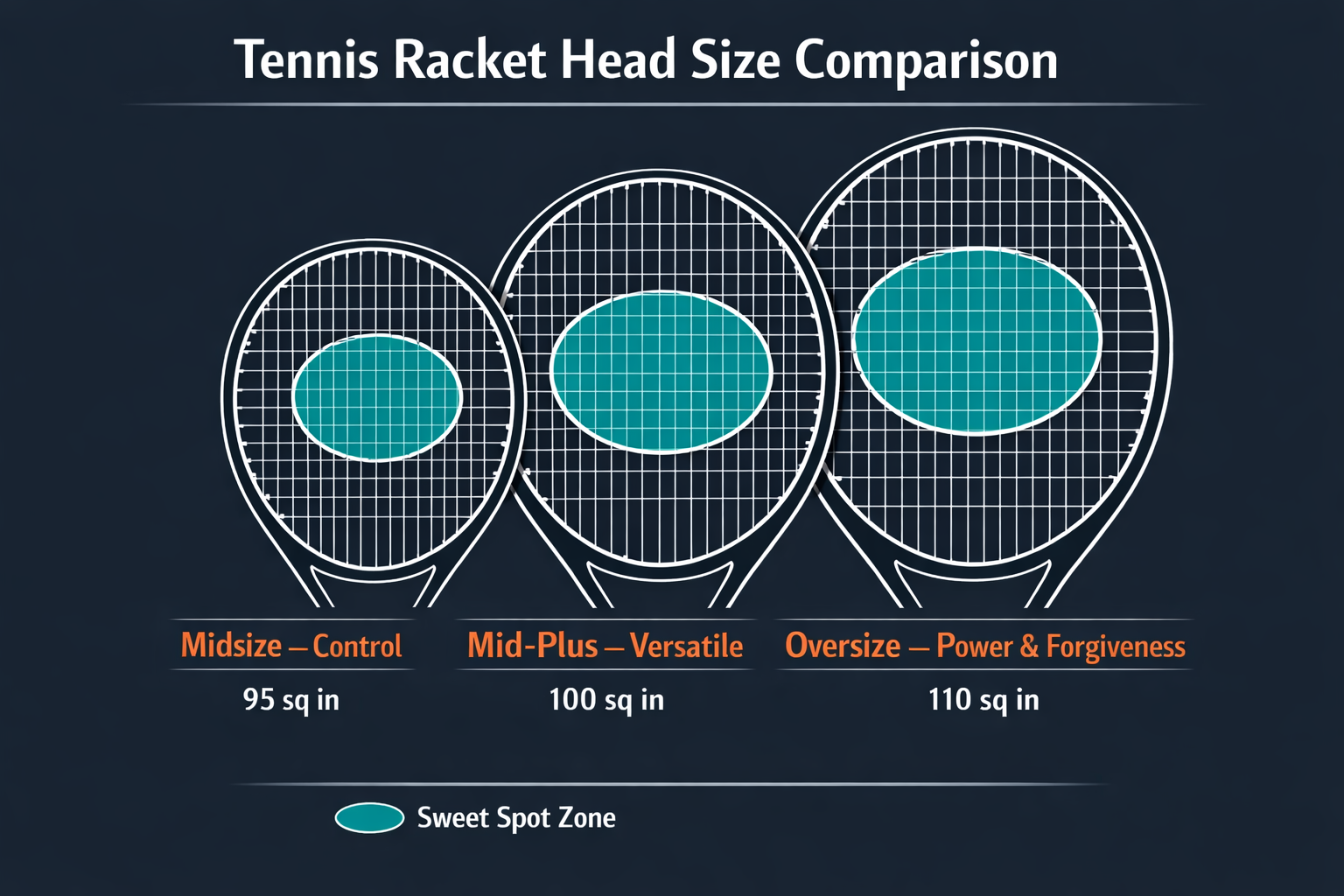
Head size, measured in square inches (sq in), determines your sweet spot size, power potential, and error forgiveness.
| Head Size | Category | Sweet Spot | Power | Control | Best For |
|---|---|---|---|---|---|
| 85–95 sq in | Midsize | Small | Low | Very High | Advanced players |
| 95–100 sq in | Mid-plus | Medium | Medium | High | Intermediate players |
| 100–110 sq in | Oversize | Large | High | Medium | Beginners, recreational |
| 110+ sq in | Super oversize | Very large | Very High | Low | Absolute beginners, seniors |
100–105 sq in is the most versatile range. It gives a big enough sweet spot for occasional mishits while still offering decent control. Most modern player rackets from HEAD, Wilson, and Babolat sit in this range.
If you are a beginner, do not buy below 100 sq in. A smaller head demands precision you do not have yet. Every off-centre hit feels jarring and goes nowhere. A 100-105 sq in head forgives your developing technique while still rewarding clean shots.
2. Weight — Heavier Is Not Stronger
Racket weight affects power, stability, and arm fatigue. Measured in grams (unstrung weight).
Lightweight (240–270g): Easy to swing, arm-friendly, but less stable on off-centre hits. The racket moves away from the ball on mishits rather than driving through it. Best for beginners, juniors, and players with arm issues (tennis elbow, shoulder pain). Most beginner rackets under ₹5,000 in our tennis rackets roundup fall in this range.
Medium weight (270–300g): The versatile range. Enough mass for stable groundstrokes and decent serve power, light enough to maneuver at the net. Suits intermediate players who play 2-3 times a week.
Heavy (300–340g): Maximum stability and plough-through power. The racket drives through the ball without deflecting, absorbing opponent pace and converting it into depth. But you need strength, fitness, and proper technique — a heavy racket amplifies bad mechanics. For advanced and competitive players.
| Player Level | Recommended Weight | Why |
|---|---|---|
| Beginner | 240–270g | Arm-friendly, easy to swing |
| Intermediate | 270–300g | Balance of power and maneuverability |
| Advanced | 300–320g | Stability and control |
| Professional | 310–340g | Maximum plough-through |
Our recommendation: Start in the 260-285g range. You can always add lead tape to increase weight later, but you cannot make a heavy racket lighter. Many intermediate players settle permanently at 280-300g and play excellent tennis.
3. Balance — Head-Heavy vs Head-Light
Like badminton, balance affects whether the racket favours power or maneuverability. But the relationship with weight is inverse in tennis:
Head-heavy + light overall weight: Common in beginner rackets. The head-heavy balance compensates for the light frame by adding mass where it contacts the ball. You get power without the arm strain of a heavy racket. This combination is forgiving and effective for developing players.
Head-light + heavy overall weight: The "player's racket" combination. The heavy frame provides stability, while the head-light balance allows fast swing acceleration through the contact zone. Demands good technique. Used by most advanced and professional players.
Even balance: Works for all levels but is less common in modern rackets. Neither specialises nor compromises.
Key insight for India: Most rackets available in the ₹3,000-10,000 range are head-heavy and lightweight — designed for recreational players. This is the right choice for most buyers. Do not seek out head-light, heavy rackets unless you play competitively 3+ times a week.
4. String Pattern — Open vs Dense
The string pattern is expressed as mains x crosses (e.g., 16x19). Fewer strings = open pattern. More strings = dense pattern.
Open pattern (16x18, 16x19): More spin potential, more power, slightly less control. The ball sinks deeper into the string bed, creating more dwell time and spin. Strings break faster because each string takes more load. This is the modern standard — most competitive rackets use 16x19.
Dense pattern (18x20, 18x19): More control, flatter shots, less spin. The ball skids off the tighter string bed with less dwell time. Strings last longer. Preferred by flat hitters and players who want precision over spin.
For most Indian players: 16x19 is ideal. It gives enough spin for modern groundstrokes while remaining controllable. Only switch to 18x20 if you specifically play flat and want laser-like precision.
5. Grip Size — Comfort and Injury Prevention
Tennis grip sizes use a number system (L1 through L5 or 1 through 5), corresponding to circumference in inches:
| Grip Size | Circumference | Hand Size |
|---|---|---|
| L1 (4 1/8") | 4.125" | Small |
| L2 (4 1/4") | 4.25" | Small-Medium |
| L3 (4 3/8") | 4.375" | Medium |
| L4 (4 1/2") | 4.5" | Medium-Large |
| L5 (4 5/8") | 4.625" | Large |
L2 and L3 are the most common sizes in India. Men typically use L3, women L2. The same finger test applies: grip the racket, and your other hand's index finger should fit in the gap between fingertips and palm.
Wrong grip size causes tennis elbow. This is not a minor comfort issue — an oversized grip forces you to squeeze harder, straining the forearm tendons. An undersized grip lets the racket twist on impact, causing wrist strain. Get this right.
Budget Tiers — What You Get at Each Price Point
| Price Range | What You Get | Who It's For |
|---|---|---|
| Under ₹2,000 | Aluminium frame, pre-strung, basic construction | Absolute beginners, casual play |
| ₹2,000–5,000 | Graphite composite, decent weight distribution, branded options | Regular recreational players |
| ₹5,000–10,000 | Full graphite, proper balance engineering, reputable brands (HEAD, Wilson) | Club players, improving intermediates |
| ₹10,000–20,000 | Advanced graphite composites, tour-level construction, premium brands | Competitive players, local tournaments |
| ₹20,000+ | Pro-spec models, custom-layup carbon, tour player signatures | State/national level, serious competitors |
The value sweet spot is ₹3,000–8,000. You get a properly engineered graphite racket from a reputable brand with good weight distribution and durable construction. Below ₹2,000, frames are heavy and dead-feeling. Above ₹10,000, you are paying for marginal performance gains that only matter at competitive level.
Common Mistakes to Avoid
Buying a "professional" racket as a beginner. A HEAD Speed Pro (310g, 100 sq in, stiff) in untrained hands is an arm injury waiting to happen. The heavy weight and stiff frame transmit every mishit vibration directly into your elbow and shoulder. Start with a lightweight, 100-105 sq in racket and upgrade as your technique develops.
Choosing based on which professional uses it. Nadal's Babolat Pure Aero is specifically customized for his playing style — the retail version is already different from his actual racket, and his technique is irrelevant to your game. Choose based on your specs (head size, weight, grip), not player endorsements.
Ignoring string tension. Pre-strung rackets come at factory tension (usually 50-55 lbs). This is fine for beginners. But if you get a racket strung, do not ask for maximum tension. Higher tension = more control but less power and more arm stress. For recreational play, 48-52 lbs offers the best combination of comfort and performance.
Over-gripping or under-gripping. Tennis requires a relaxed grip during rallies and firm grip only at contact. A too-large grip makes relaxing difficult. A too-small grip makes the racket wobble. Many Indian players use L4 when they need L3 — always check with the finger test before buying.
See Our Tested Rankings
We rank tennis rackets from HEAD, Wilson, and Babolat, with detailed scoring on power, control, comfort, and value.
Best Tennis Rackets in India (2026) →→Frequently Asked Questions
All three are excellent. HEAD offers the widest range in the ₹5,000-15,000 bracket in India and has strong availability. Wilson's Blade and Clash series are popular for their comfort and feel. Babolat is the benchmark for spin-oriented play (Pure Aero series). Availability and after-sales service vary by city — HEAD typically has the best dealer network in India.
The rule of thumb: replace strings as many times per year as you play per week. If you play twice a week, restring twice a year. Polyester strings lose tension faster than synthetic gut. Signs it is time: strings feel 'dead' (no pop), fraying visible, or you cannot generate the spin you used to. Most recreational players restring every 3-6 months.
No. Padel uses a solid, perforated paddle — completely different from a strung tennis racket. The games share a court layout similarity, but equipment is not interchangeable. Padel is growing in India, but dedicated padel equipment is still harder to find than tennis gear.
Look for: lightweight (under 280g), flexible frame (stiffness rating below 63), larger head (102-110 sq in), and arm-friendly string (multifilament or natural gut, not polyester). The Wilson Clash series is specifically designed for arm-friendliness. Also check your grip size — wrong grip is a common elbow aggravator.