Pickleball Paddle Buying Guide India — How to Choose the Right Paddle
Pickleball paddle buying guide for India — core material, face texture, weight, grip size, and price tiers explained. Expert advice for beginners to competitive players.
Pickleball is the fastest-growing racquet sport in India, and paddle selection is simpler than badminton or tennis — fewer variables, fewer bad choices. But that simplicity means small differences between paddles matter more. The wrong core material or face texture can cost you control at the net or power on drives. This guide covers everything that matters and nothing that does not. For our tested and ranked picks, see our best pickleball paddles roundup.
Key Decision Factors
1. Core Material — The Heart of Your Paddle
The core is the honeycomb layer between the two face sheets. It determines feel, power, and control more than any other component.
Polymer (Polypropylene) Honeycomb: The most common and most versatile core. Softer feel, excellent control, quieter on impact. Used in 80%+ of modern paddles. Best for all skill levels — beginners get forgiveness, advanced players get touch at the net. If you are buying your first paddle, get a polymer core.
Nomex Honeycomb: Harder, louder, and more powerful. Nomex is an aramid fiber material (same family as Kevlar). It generates more pop on drives and smashes but offers less control than polymer. Common in power-focused paddles. The loud "crack" sound is distinctive — some clubs and apartment buildings restrict Nomex paddles for noise reasons.
Aluminium Honeycomb: The softest core option. Maximum touch and control, minimum power. Used in specialized control paddles favoured by players with a soft-game strategy. Less common in India.
| Core Type | Power | Control | Noise | Best For |
|---|---|---|---|---|
| Polymer | Medium | High | Quiet | All-round play, beginners |
| Nomex | High | Medium | Loud | Power players, outdoor play |
| Aluminium | Low | Very High | Quiet | Net players, touch shots |
Our recommendation: Polymer core for 95% of Indian players. It is the most forgiving, works in all conditions, and does not annoy your neighbours.
2. Face Material — What Touches the Ball
The face determines spin potential, durability, and power transfer.
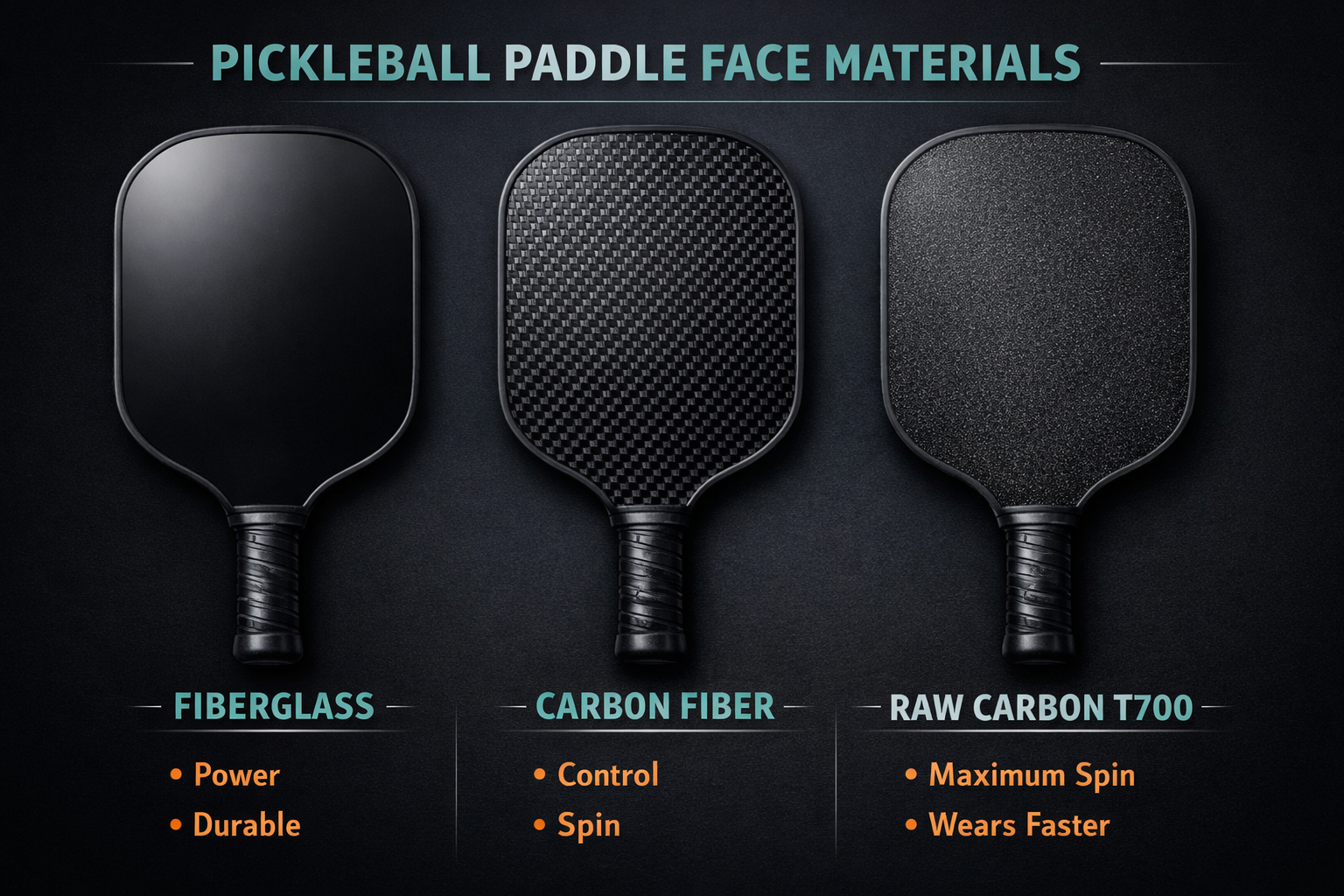
Fiberglass (Glass Fiber): Most common face material in budget to mid-range paddles. Good pop and power, decent spin. Slightly heavier than carbon fiber. Best for beginners and intermediate players — forgiving and durable. Most paddles under ₹3,000 use fiberglass faces.
Carbon Fiber: Stiffer and lighter than fiberglass. Better touch, more consistent feel, and superior spin generation due to the textured surface. Common in mid-range to premium paddles (₹3,000+). If you play regularly and want to improve your spin game, carbon fiber is worth the upgrade.
Raw Carbon / T700 Carbon: The latest evolution — uncoated carbon fiber with a gritty texture that grips the ball for maximum spin. Found in paddles above ₹4,000, with pro-level options using multi-layer T700 construction. The spin advantage is real and measurable, but the textured surface wears down faster than coated faces.
3. Weight — Lighter Is Not Always Better
Paddle weight affects power, control, and arm fatigue. Measured in ounces (oz) — the international standard for pickleball.
| Weight Range | Category | Power | Control | Best For |
|---|---|---|---|---|
| Under 7.3 oz | Lightweight | Low | High | Touch players, arm issues |
| 7.3–7.8 oz | Midweight | Medium | High | All-round play, most players |
| 7.8–8.4 oz | Standard | High | Medium | Power players, drives |
| Over 8.4 oz | Heavy | Very High | Lower | Pure power, strong arms |
7.3–7.8 oz is the sweet spot for most Indian players. This range gives enough mass for decent drives and volleys while staying light enough for quick net exchanges. If you have any history of tennis elbow or wrist pain, go lighter — heavy paddles amplify arm strain over long sessions.
4. Paddle Shape — Standard vs Elongated
Standard shape (16" x 8"): Wider face, larger sweet spot. More forgiving on off-centre hits. Better for beginners and all-round play.
Elongated shape (16.5" x 7.5"): Taller and narrower. More reach on overhead shots and drives. Smaller sweet spot — rewards accurate players, punishes inconsistency. Popular with singles players and former tennis/badminton players who have good hand-eye coordination.
Our recommendation: Start with standard shape. The larger sweet spot compensates for developing technique. Switch to elongated only if you consistently make clean contact and want the extra reach.
5. Grip Size and Length — Comfort and Control
Grip circumference: Measured in inches. Most paddles come in 4" to 4.5". Indian players with medium-sized hands typically prefer 4" to 4.25". Too-large grips reduce wrist mobility; too-small grips cause the paddle to twist on impact.
Handle length: Ranges from 4.5" to 5.5". Longer handles accommodate two-handed backhands (common among players transitioning from tennis). Shorter handles give more face area for a given paddle length.
Quick test: Hold the paddle naturally. Your index finger from your other hand should fit snugly in the gap between your fingertips and palm. If there is no gap, the grip is too big. You can build up a small grip with overgrip tape, but you cannot reduce a large grip.
6. Edge Guard — Protection vs Playability
Most paddles have a raised edge guard around the perimeter to protect the face from ground hits. Some premium paddles use a low-profile or edgeless design to maximize the usable face area. For beginners, a standard edge guard is better — it protects the paddle during the inevitable ground scrapes. Advanced players may prefer edgeless for the larger sweet spot near the edges.
Price Tiers — What You Get at Each Level
| Price Range | What You Get | Who It's For |
|---|---|---|
| Under ₹1,000 | Basic polymer core, fiberglass face, standard shape | Casual trial, not sure if you'll stick with pickleball |
| ₹1,000–2,500 | Good polymer core, fiberglass face, proper weight distribution | Regular recreational play, beginners |
| ₹2,500–4,000 | Carbon fiber face, better balance, improved grip | Club players, intermediate competitive play |
| ₹4,000–6,000 | Raw carbon face, premium core, optimized weight, elongated options | Competitive players, tournament play |
| ₹6,000+ | Pro-level construction, USA-approved for tournaments, maximum spin | Serious competitive players |
The best value sits in the ₹1,500–3,000 range. You get a properly engineered paddle with decent materials that will last 1-2 years of regular play. Below ₹1,000, quality drops sharply. Above ₹4,000, improvements are incremental.
Common Mistakes to Avoid
Buying a heavy, power-focused paddle as a beginner. Pickleball is a control game — 80% of points are won on errors, not winners. A heavy paddle that helps you hit harder also makes your mistakes travel further and faster. Start with a midweight (7.3–7.8 oz) paddle and develop your dink and drop game first.
Choosing Nomex core for indoor/apartment play. Nomex paddles are loud. If you play in a housing society, club, or indoor court, the sharp cracking sound will generate complaints. Polymer core is noticeably quieter and plays better indoors.
Ignoring face texture wear. Textured carbon fiber faces lose their grit over time, reducing spin potential. If spin is central to your game, budget for a new paddle every 12-18 months. Fiberglass faces are more durable but offer less spin from day one.
Buying paddles marketed as "USA tournament approved" when you play recreationally. USA Pickleball approval means the paddle meets specific weight, size, and deflection standards. Unless you are entering sanctioned tournaments, this certification adds cost without benefit. Many excellent Indian-market paddles are not USA-approved but play beautifully for recreational and club use.
See Our Tested Rankings
We rank the best pickleball paddles from ₹1,799 to ₹4,999, with detailed scoring on spin, control, power, and build quality.
Best Pickleball Paddles in India (2026) →→Frequently Asked Questions
Yes. Tennis overgrips work perfectly on pickleball paddles and are widely available in India from brands like Yonex and Wilson. They add ~1mm to grip circumference and improve sweat absorption. Replace every 2-4 weeks with regular play.
Pickleball is significantly easier on the joints. The court is smaller (20x44 feet vs badminton's 20x44 feet), the paddle is lighter than most badminton rackets, and the plastic ball moves slower than a shuttle. The underhand serve reduces shoulder stress. Pickleball is popular with 40+ age groups in India partly for this reason.
A mid-range paddle (₹2,000-4,000) lasts 1-2 years of regular play (3-4 times per week). The core rarely fails — it is usually face delamination (face separating from core) or edge guard cracking that ends a paddle's life. Textured carbon faces lose spin effectiveness in 8-12 months. Budget paddles under ₹1,000 may last only 3-6 months.
Not necessarily, but preferences differ. Singles players often prefer elongated, slightly heavier paddles for reach and drive power. Doubles players prefer standard shape, lighter paddles for quick reactions at the non-volley zone (kitchen). If you play both, a standard-shape midweight paddle is the best compromise.