Can Your Tennis Racket Give You Tennis Elbow?
Up to 50% of regular tennis players get tennis elbow. Your racket specs may be the biggest reason — not how much you play.
Up to 50% of regular tennis players will experience tennis elbow at some point — and most assume it's because they're playing too much. They rest for weeks, come back, and the pain returns within days. The reason: they changed their schedule but not their racket. Sports medicine research consistently shows that racket specifications — grip size, frame stiffness, weight, string tension, and head size — contribute more to tennis elbow than playing frequency alone.
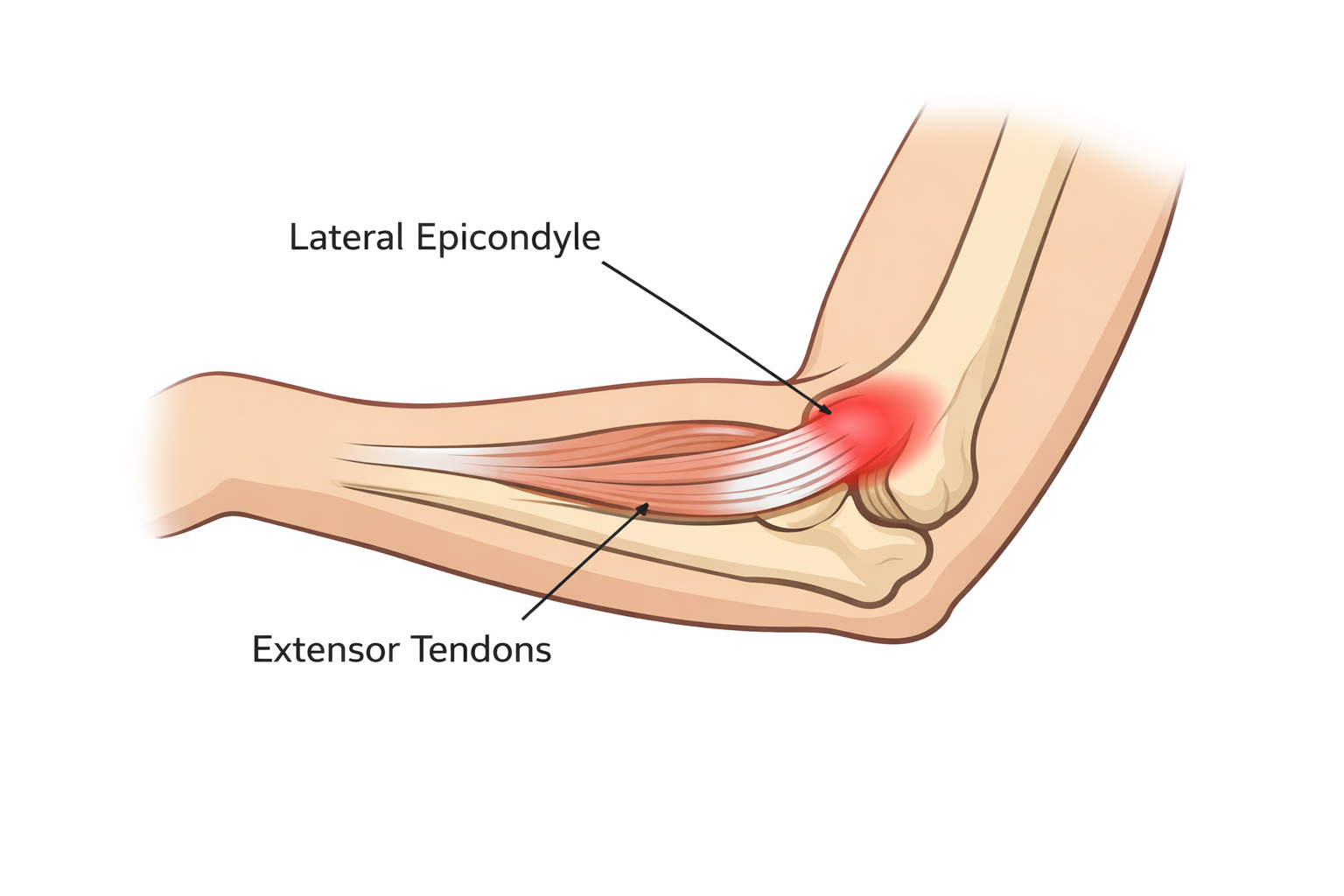
Tennis elbow (lateral epicondylitis) is inflammation of the tendons that attach your forearm muscles to the bony bump on the outside of your elbow. Every time you grip the racket and make contact with the ball, those tendons absorb force. The wrong racket amplifies that force. The right racket reduces it. Understanding which specs matter — and why — can be the difference between playing pain-free and quitting the sport.
The Five Racket Specs That Affect Your Elbow
Not all specs matter equally. Here's what the research says, ranked by impact.
1. Grip Size — The Most Common Culprit
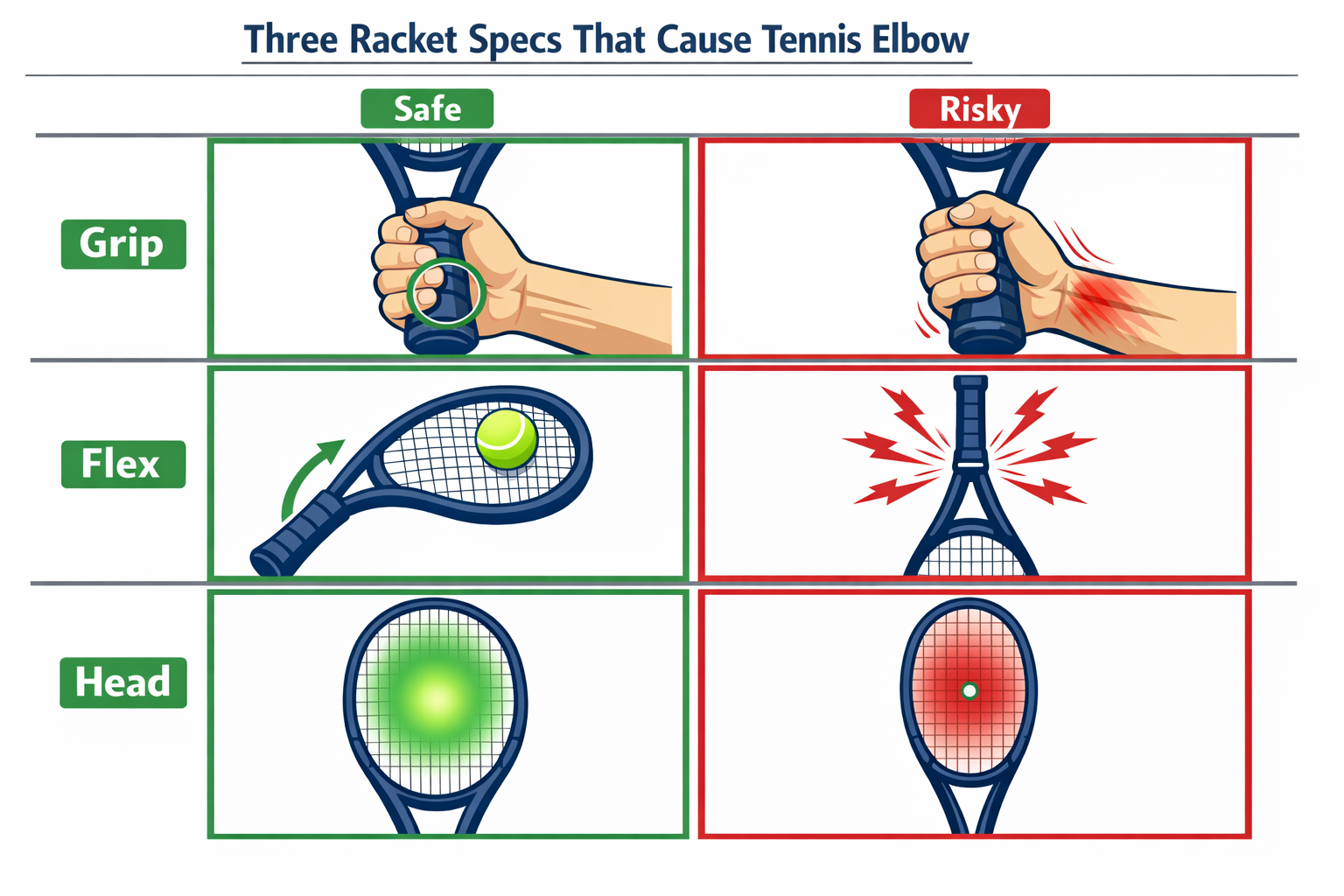
A grip that's too small forces your hand to squeeze harder on every shot to prevent the racket from twisting on impact. That constant over-gripping strains the extensor tendons — the exact tendons that become inflamed in tennis elbow. Sports medicine studies show that an undersized grip increases forearm muscle activation by 20-30% compared to a correctly fitted grip.
A grip that's too large is less common but equally problematic — it restricts wrist mobility, forcing your forearm to compensate on every swing.
The fix: Hold the racket in your playing hand. Slide your other hand's index finger into the gap between your fingertips and palm. It should fit snugly. If there's no gap, the grip is too large. If your finger rattles around, it's too small. Most Indian men need L3 (4 3/8"), most women L2 (4 1/4"). You can build up a small grip with overgrip tape, but you cannot shrink a large one.
2. Frame Stiffness — The Silent Aggressor
Frame stiffness is measured in RA units (typically 55-75). Stiffer frames generate more power because they don't flex on impact — but that rigidity also transmits vibration directly into your arm. Every off-centre hit on a stiff frame sends a jolt through the handle into your elbow.
Frames above 68 RA are considered stiff. Most "power" rackets marketed to beginners fall in this range — which is ironic because beginners mishit the most, generating the most vibration on the frame they're least equipped to handle.
Flexible frames (below 63 RA) absorb impact energy by bending slightly on contact. You lose some power, but your arm absorbs significantly less shock. The Wilson Clash series, for example, was specifically engineered with a low stiffness rating for arm-friendliness.
The fix: If you have elbow pain, switch to a frame with stiffness below 65 RA. You'll lose marginal power but gain significant comfort. Most players can't tell the difference in power — they can absolutely feel the difference in arm comfort.
3. Racket Weight — Heavier Isn't Always Worse
This one is counterintuitive. Many players switch to a lighter racket when their elbow hurts, assuming less weight means less strain. In reality, very light rackets (under 260g) can make tennis elbow worse.
A light racket has less mass to absorb the ball's impact energy. When a heavy ball meets a light racket, the racket decelerates and vibrates more — that vibration transfers to your arm. A heavier racket (280-310g) ploughs through the ball, absorbing impact with its own mass rather than your forearm tendons.
The catch: a heavy racket requires more arm strength to swing repeatedly. If your muscles fatigue, your technique breaks down, and bad technique causes more elbow strain than racket weight ever could.
The fix: Aim for 270-290g — heavy enough to absorb impact, light enough to swing without fatigue. If your current racket is very light, add lead tape to the head (3-5g at the 3 and 9 o'clock positions) before buying a new one — this is the cheapest experiment you can run.
4. String Tension and Type — The Overlooked Factor
Higher string tension means a stiffer string bed — which means less dwell time (the milliseconds the ball stays on the strings) and sharper impact shock. Tournament players string at 55-60 lbs for control. Recreational players with elbow issues should drop to 48-52 lbs.
String material matters even more than tension. Polyester strings are stiff, durable, and generate excellent spin — but they transmit more vibration than any other string type. Multifilament strings (made of hundreds of microfibers) are softer, absorb more shock, and are significantly easier on the arm. Natural gut is the gold standard for arm-friendliness but costs 3-4x more and breaks faster.
The fix: If you're using polyester strings and have elbow pain, switch to multifilament immediately. Drop tension by 2-3 lbs below your current level. This single change resolves elbow pain for many recreational players — and costs just ₹300-500 for a restring.
5. Head Size — Bigger Is Safer
A larger head (100-110 sq in) has a bigger sweet spot — meaning more of your hits land in the zone where vibration is minimal. A smaller head (85-98 sq in) has a concentrated sweet spot — off-centre hits generate significantly more frame vibration.
Advanced players use smaller heads for precision. But if you're experiencing elbow pain, a larger head reduces the number of jarring mishits per session.
The fix: If you're below 100 sq in and experiencing pain, try a 100-105 sq in racket. You'll lose some precision but gain a lot of comfort.
Choosing an arm-friendly racket
Our buying guide explains grip sizing, weight ranges, and frame stiffness in detail — with specific recommendations for each skill level.
Read the Tennis Racket Buying Guide →→When It's Not the Racket
Racket specs are a major factor, but not the only one. Tennis elbow also results from:
- Poor technique — hitting with a locked wrist, leading with the elbow on backhands, or gripping too tightly during rallies. A coach can identify and fix these in one session.
- Playing surface — hard courts generate more impact than clay. If you play on concrete courts (common in India), your arm absorbs more shock per hit.
- Sudden increase in play — going from once a week to daily without conditioning. Your tendons need time to adapt to increased load.
- Age — tendons lose elasticity after 30. Players in the 35-55 age group are most susceptible, which is also the age group most active in club tennis in India.
When to See a Doctor
Most tennis elbow resolves with racket changes, technique adjustment, and rest. But see a sports medicine doctor or orthopaedic specialist if:
- Pain persists after 4-6 weeks of racket changes and reduced play
- You cannot grip everyday objects (coffee cups, door handles) without pain
- Pain wakes you up at night
- You notice swelling or warmth around the elbow
- Pain radiates down your forearm into your wrist
Treatment ranges from physiotherapy and bracing to PRP injections and, rarely, surgery. The earlier you address it, the faster the recovery — most cases resolve in 6-12 weeks with conservative treatment.
See our tested tennis racket picks
We rank 12 rackets from beginner to advanced, with arm-friendliness noted in each review.
Best Tennis Rackets in India (2026) →→Key Takeaways
- Grip size is the #1 racket-related cause of tennis elbow. Get fitted properly — the finger test takes 10 seconds.
- Frame stiffness above 65 RA transmits significantly more vibration. Switch to a flexible frame if you have elbow pain.
- Lighter rackets can make it worse, not better. The 270-290g range absorbs impact without causing fatigue.
- Switching from polyester to multifilament strings is the cheapest fix — ₹300-500 for a restring that may resolve your pain entirely.
- If pain persists beyond 6 weeks despite equipment changes, see a doctor. Tennis elbow is treatable — ignoring it makes it chronic.