Indoor Game Tables Buying Guide India — Table Tennis, Pool, Foosball & Air Hockey
Indoor game tables buying guide for India — table tennis, pool, foosball, and air hockey. Space requirements, surface quality, build construction, and price tiers explained.
Indoor game tables are the kind of purchase you get wrong once and live with for years — they are too heavy to return and too expensive to replace casually. The two things most buyers misjudge are space (the table fits, but you cannot actually play on it) and surface quality (the table looks fine, but the ball bounces inconsistently). This guide covers what matters for each game type so you buy right the first time.
Space Requirements — Measure Before You Browse
This is the single biggest source of buyer regret. A table tennis table is 9x5 feet, but you need at least 5 feet of clearance on each end and 3 feet on each side to actually play. A pool table needs 5+ feet on all sides for cue strokes. Measure your room first, then shop.
| Game | Table Dimensions | Minimum Room Size | Ideal Room Size |
|---|---|---|---|
| Table Tennis | 9 x 5 feet | 17 x 11 feet | 22 x 14 feet |
| Pool (7ft) | 7 x 3.5 feet | 17 x 13 feet | 19 x 15 feet |
| Pool (8ft) | 8 x 4 feet | 18 x 14 feet | 20 x 16 feet |
| Foosball | 4.5 x 2.5 feet | 10 x 8 feet | 12 x 10 feet |
| Air Hockey | 7 x 4 feet | 15 x 10 feet | 17 x 12 feet |
| Mini Pool | 4 x 2 feet | 12 x 10 feet | 14 x 12 feet |
Ceiling height matters too. Table tennis requires overhead clearance for serves and high loops — 9 feet minimum ceiling height. Pool requires space for vertical cue strokes near walls — not a problem in most Indian homes, but check if you have low-hanging fans or lights above the planned table position.
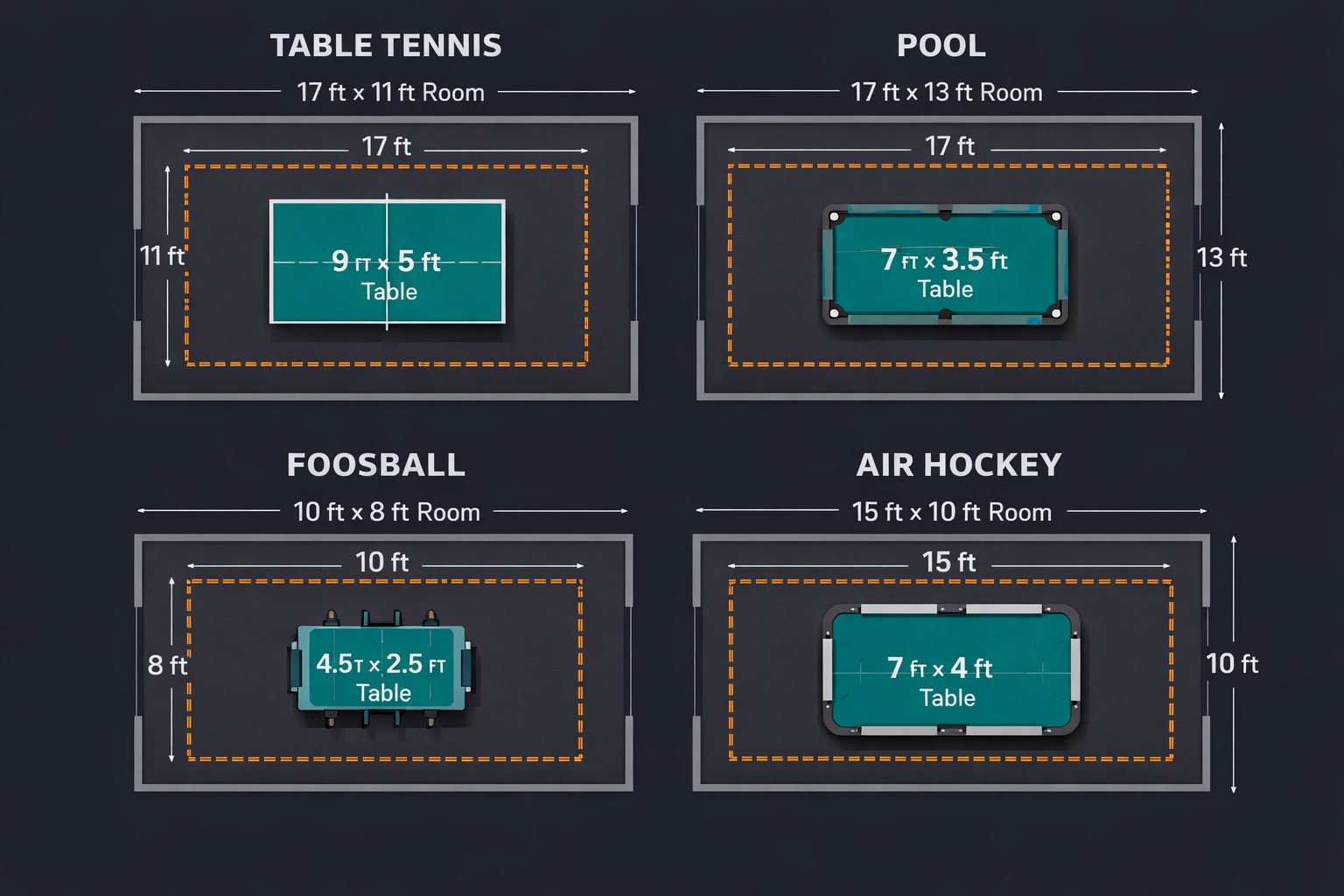
Table Tennis Tables
Surface Thickness — The Quality Indicator
Table surface thickness directly determines bounce consistency. This is the single most important spec.
| Thickness | Bounce Quality | Use Case | Price Range |
|---|---|---|---|
| 12mm | Poor, inconsistent | Basic recreational, kids | Under ₹10,000 |
| 15-16mm | Acceptable | Regular home play | ₹10,000–20,000 |
| 18-19mm | Good | Serious recreational, coaching | ₹15,000–30,000 |
| 22-25mm | Excellent | Club level, tournaments | ₹25,000–60,000 |
| 25mm+ | Professional | ITTF-approved tournaments | ₹50,000+ |
Our recommendation: 18mm minimum for any adult who wants a consistent game. Below 18mm, the ball bounces differently in different spots — especially near the edges and net — which makes practice pointless because you cannot develop consistent strokes.
Indoor vs Outdoor
Indoor tables have MDF or particleboard surfaces with a smooth coating. They provide the best bounce consistency and are suitable for serious play. They cannot handle moisture — humidity warps the surface, and rain destroys it. Keep indoor tables in air-conditioned or well-ventilated rooms.
Outdoor tables use aluminium composite or melamine-resin surfaces that resist weather, UV, and moisture. The bounce is slightly different from indoor tables — harder and faster. They cost 30-50% more than equivalent indoor tables. Worth it if you plan to play on a terrace, balcony, or garden.
Foldability and Storage
Most home tables fold in half for storage. Look for:
- Playback mode: One half folds up so you can practice alone against the vertical half. Essential for solo training.
- Locking wheels: The table should lock in both play position and storage position. Unlocked tables roll and create gaps during play.
- Safety latch: Prevents accidental unfolding during storage. Critical if you have children.
For our tested and ranked picks, see our best table tennis tables roundup.
Pool / Billiards Tables
Slate vs MDF — The Only Debate That Matters
Slate bed: A slab of precision-ground natural slate beneath the felt. Perfectly flat, heavy, and durable. Provides a true, consistent ball roll that MDF cannot match. Minimum 3/4-inch (19mm) thickness for any serious play. One-piece slate is better than three-piece (fewer seams), but three-piece is easier to move through doors and staircases. Slate tables start around ₹40,000 and weigh 200-400 kg.
MDF bed: Medium-density fiberboard as the playing surface. Lighter, cheaper, and easier to move. But MDF warps over time — humidity, temperature changes, and even the table's own weight cause gradual bowing. A new MDF table plays fine; a 2-year-old MDF table plays noticeably worse. MDF tables range from ₹15,000-40,000.
Our recommendation: If you are spending above ₹35,000 and plan to keep the table for 5+ years, get slate. If you need a table for casual family entertainment and may move homes, MDF is pragmatic.
Table Size
| Size | Recommended For | Room Needed |
|---|---|---|
| 6 feet | Small rooms, casual play, kids | 16 x 12 feet |
| 7 feet | Home recreation, bar-size standard | 17 x 13 feet |
| 8 feet | Serious home play, regulation practice | 18 x 14 feet |
| 9 feet | Tournament regulation | 19 x 15 feet |
7-foot is the most popular home size in India. It fits in most living rooms with adequate cue clearance. If you want a mini pool table for tight spaces, 4-foot tabletop models are available but the gameplay experience is significantly different from a full table.
For our tested picks, see our best pool tables roundup.
Foosball Tables
Rod Type — Telescoping vs Solid
Solid rods: Steel rods that extend out the opposite side when you push. More responsive and preferred by competitive players. The downside: exposed rod ends can poke bystanders, especially children. A safety concern in homes with young kids.
Telescoping rods: Rods that collapse into themselves instead of protruding. Safer for home use, especially with children around. Slightly less responsive than solid rods — there is a tiny amount of play in the telescoping mechanism. This difference matters to competitive foosballers but is irrelevant for home entertainment.
Player Figures (Men)
Counterbalanced men: Figures weighted so they return to horizontal when released. This means uncontrolled players do not block the ball — only the figures you actively control affect play. Standard in quality tables and important for fair gameplay.
Non-counterbalanced men: Figures that stay where you leave them, often dangling down and randomly blocking shots. Cheaper tables use these. Frustrating during actual games.
Surface and Build
- Playing surface: Should be smooth, flat, and consistent. MDF is standard. Tempered glass surfaces exist in premium tables but add significant cost.
- Leg levelers: Adjustable feet to compensate for uneven floors. Essential — even a slight tilt makes the ball drift.
- Goal design: Cup-style goals (ball drops out the bottom) are easier to retrieve than ramp-return goals. Both work fine.
For our tested picks, see our best foosball tables roundup.
Air Hockey Tables
Blower System — The Non-Negotiable
Air hockey requires an even air cushion across the entire playing surface. The blower system pumps air through hundreds of tiny holes in the table surface, creating a frictionless layer for the puck to glide on.
Single-fan systems are common in budget tables. The air distribution is uneven — strong near the centre, weak at edges and corners. The puck slows down noticeably near the walls. Playable but not satisfying.
Dual-fan or commercial-grade blowers distribute air more evenly. The puck glides consistently from wall to wall. Worth paying more for. Any table above ₹15,000 should have an adequate blower.
Quick test when buying: Place the puck at different spots on the table (centre, corners, edges) and give it a light push. It should glide smoothly everywhere. If it sticks or slows in certain areas, the blower distribution is inadequate.
Surface and Scoring
- Surface material: High-pressure laminate (HPL) or PVC are common. HPL is more durable and provides a smoother glide.
- Electronic scoring: LED scoreboards add convenience. Manual slide scorers work fine and do not require power.
- Puck and mallet quality: Stock pucks and mallets are usually adequate. If they feel too light, aftermarket options are available cheaply.
For our tested picks, see our best air hockey tables roundup.
Common Mistakes to Avoid
Not measuring the room with playing clearance. The most common mistake. A 7-foot pool table fits in a 10x12 room. But you need 5 feet of clearance on each side for cue strokes, making the actual room requirement 17x13 feet. Many buyers realize this after delivery when they cannot make shots near the walls.
Buying the cheapest table tennis table for "serious practice." A 12mm surface table costs ₹6,000-8,000. An 18mm surface costs ₹15,000-20,000. The 12mm table has dead spots, inconsistent bounce near edges, and teaches bad habits because you adjust your game to the table rather than developing proper technique. If you want to improve, 18mm is the minimum.
Ignoring assembly and delivery logistics. Full-size pool tables weigh 150-400 kg and often require partial disassembly to fit through doors and stairways. Slate tables require professional installation and leveling. Budget for delivery and assembly (₹2,000-5,000 extra) and confirm the delivery path — measure doorways, staircase turns, and elevator dimensions.
Placing tables in humid or unventilated rooms. MDF surfaces (table tennis, foosball, air hockey) warp in high humidity. Pool table felt absorbs moisture and develops mold. Place game tables in air-conditioned rooms or rooms with good ventilation. Indian monsoon humidity is especially damaging — if your game room is not climate-controlled, invest in outdoor-rated tables or a dehumidifier.
Browse Our Game Table Rankings
We rank the best indoor game tables across table tennis, pool, foosball, and air hockey, with detailed scoring on build quality, playability, and value.
Best Table Tennis Tables in India (2026) →→Frequently Asked Questions
A foosball table offers the best combination of value, space efficiency, and family fun. It needs the least room (10x8 feet), costs ₹8,000-25,000, is easy to learn for all ages, and games are fast-paced. Table tennis is excellent too but needs a larger room. Pool requires the most space and highest budget.
Only if you buy an outdoor-rated table with an aluminium composite or melamine surface. Standard indoor MDF tables will warp within weeks of exposure to sun, rain, or humidity. Outdoor tables cost 30-50% more but are built to handle Indian weather conditions. Cover the table when not in use regardless.
Professional re-felting costs ₹5,000-15,000 depending on the table size and felt quality. Standard worsted cloth is cheaper; speed cloth (used in tournaments) costs more. Re-felting is needed every 3-5 years with regular play, or sooner if you notice worn spots, pilling, or the ball rolling off-line.
Multi-game tables (3-in-1 or 4-in-1 combinations) are convenient for small spaces but compromise on every game. The table tennis surface is thinner, the pool bed is MDF, the foosball rods are basic, and the air hockey blower is weak. If you care about playing quality for any one game, buy a dedicated table. Multi-game tables are acceptable only for very casual family entertainment.