How Induction Cooktops Work — And Why They're Faster Than Gas
A clear, visual explanation of the science behind induction cooking — electromagnetic heating, efficiency gains, and why your cookware matters.
Most people know induction cooktops are "faster" and "more efficient" than gas — but few understand why. The answer is surprisingly elegant: induction doesn't generate heat at all. It makes your cookware generate its own heat.
This distinction changes everything — from which pans work to how much energy you save. Here's how it actually works, explained without jargon.
The Core Principle: Magnetic Induction
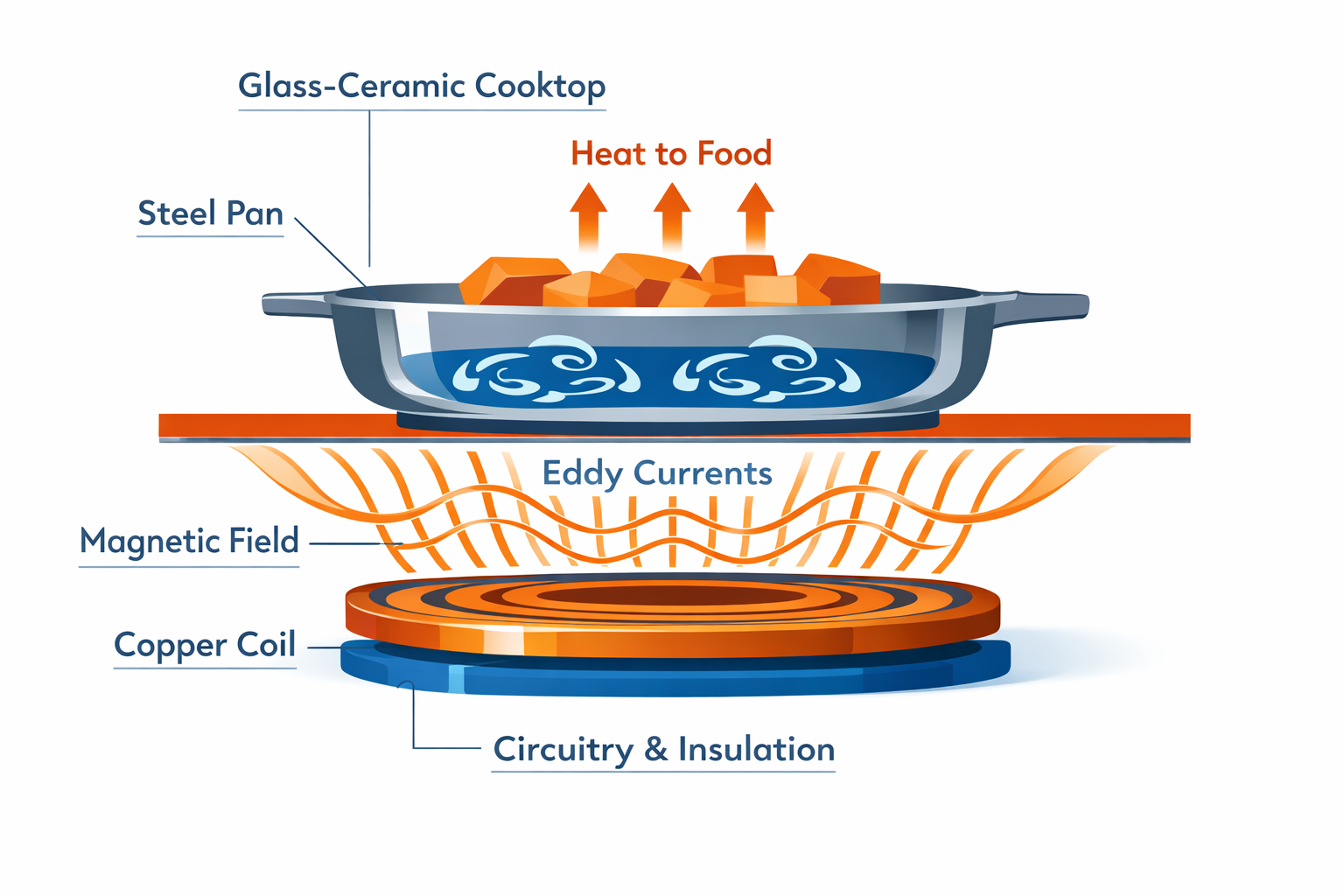
Under the glass-ceramic surface of an induction cooktop sits a coil of copper wire. When you turn it on, alternating current flows through this coil at high frequency (20,000–100,000 Hz), creating a rapidly oscillating magnetic field.
When you place a ferromagnetic pan (cast iron, stainless steel with magnetic base) on top, this magnetic field induces tiny electrical currents — called eddy currents — inside the pan's base. These currents meet resistance in the metal, and that resistance generates heat. The pan itself becomes the heating element.
This is why:
- The glass stays relatively cool — it's not being heated directly
- There's no wasted heat — energy goes straight into the pan, not the surrounding air
- Heating is instant — no waiting for a burner or coil to warm up
Think of it like a wireless phone charger, but instead of transferring power to a battery, the energy is converted to heat in the pan's base.
Why Induction Is Faster Than Gas
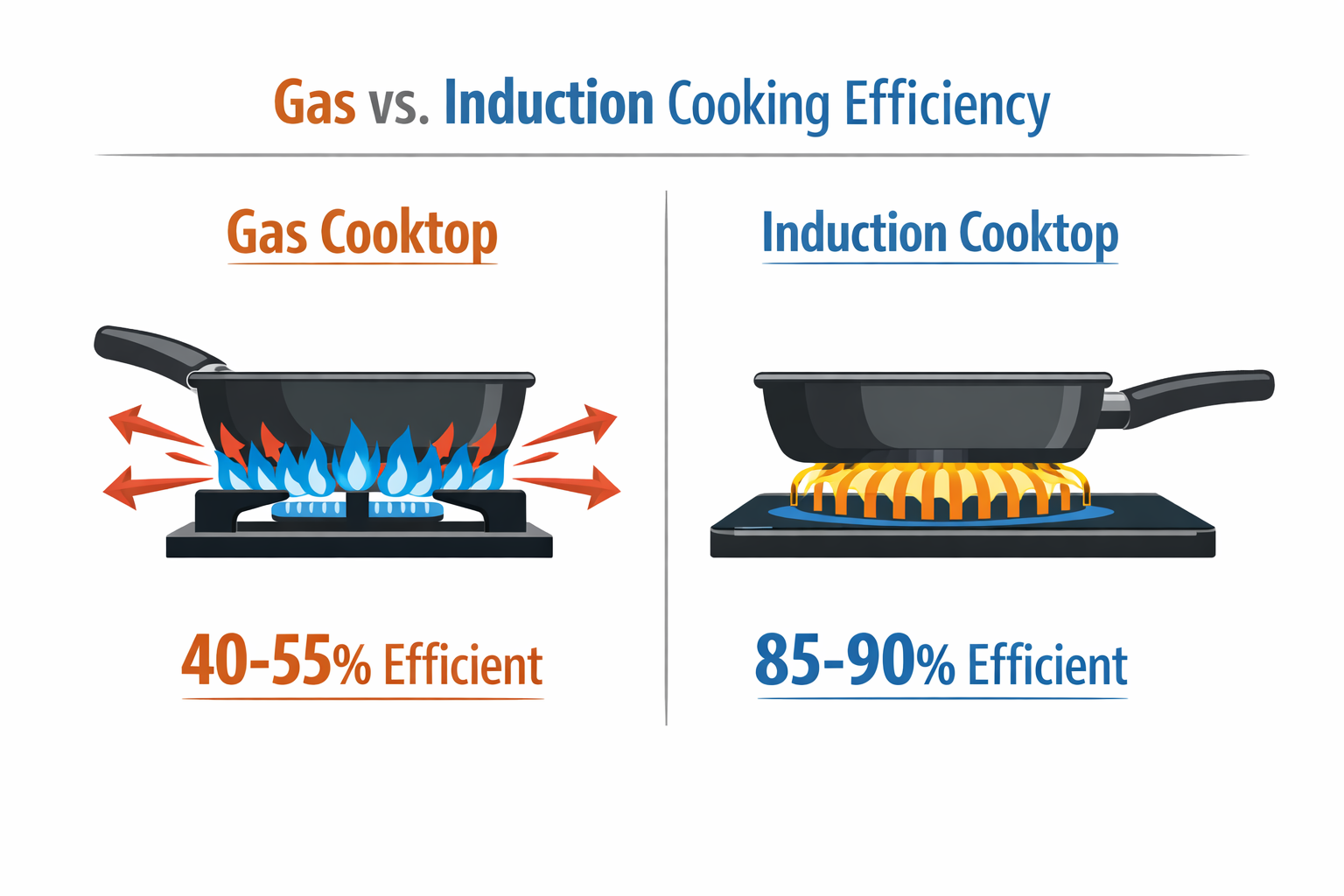
Gas burners heat by combustion — flames wrap around the bottom of the pan. But a significant portion of that heat escapes sideways into the kitchen air. Studies consistently show gas transfers only 40-55% of its energy into the food.
Induction transfers 85-90% of its energy directly into the cookware. No flames, no hot air, no wasted heat.
In practical terms: 2 litres of water boils in ~4 minutes on induction vs ~8 minutes on gas. That's not a marginal improvement — it's nearly twice as fast.
The Cookware Question
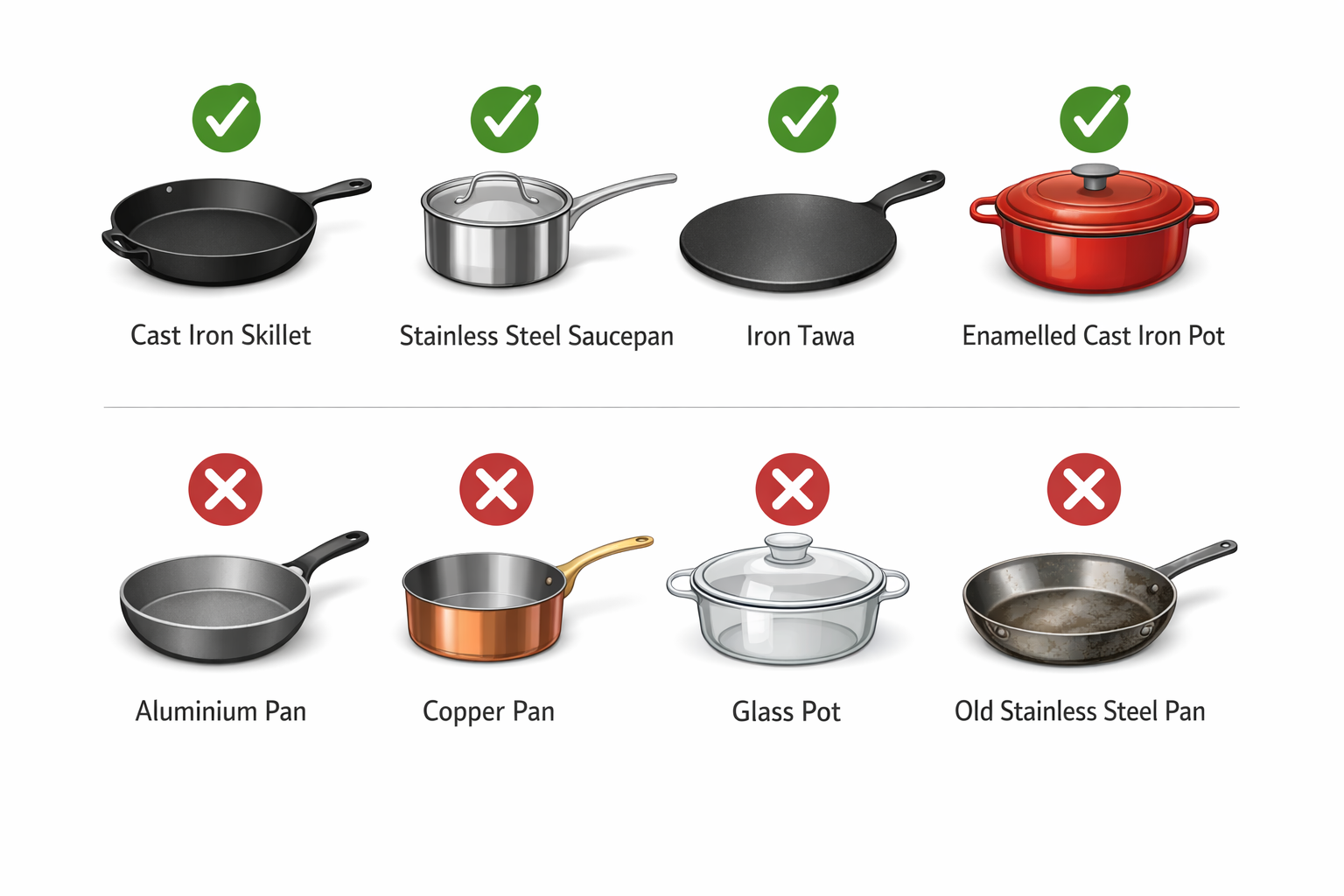
Since induction relies on magnetic fields, your cookware must be ferromagnetic. The simple test: if a fridge magnet sticks to the bottom, it works on induction.
Works on induction:
- Cast iron (tawa, kadhai, skillets)
- Stainless steel with magnetic base (most modern cookware)
- Enamelled cast iron
- Induction-specific non-stick pans (have a magnetic base layer)
Does NOT work on induction:
- Pure aluminium
- Pure copper
- Glass or ceramic
- Non-magnetic stainless steel (older sets)
Most Indian households already have cast iron tawas and kadhais that work perfectly. If you need new cookware, induction-compatible sets start at ₹1,500-2,500.
Need induction-compatible cookware?
We've tested and ranked the best induction cookware sets available in India — from budget to premium.
See Our Top Picks →→How Temperature Control Works
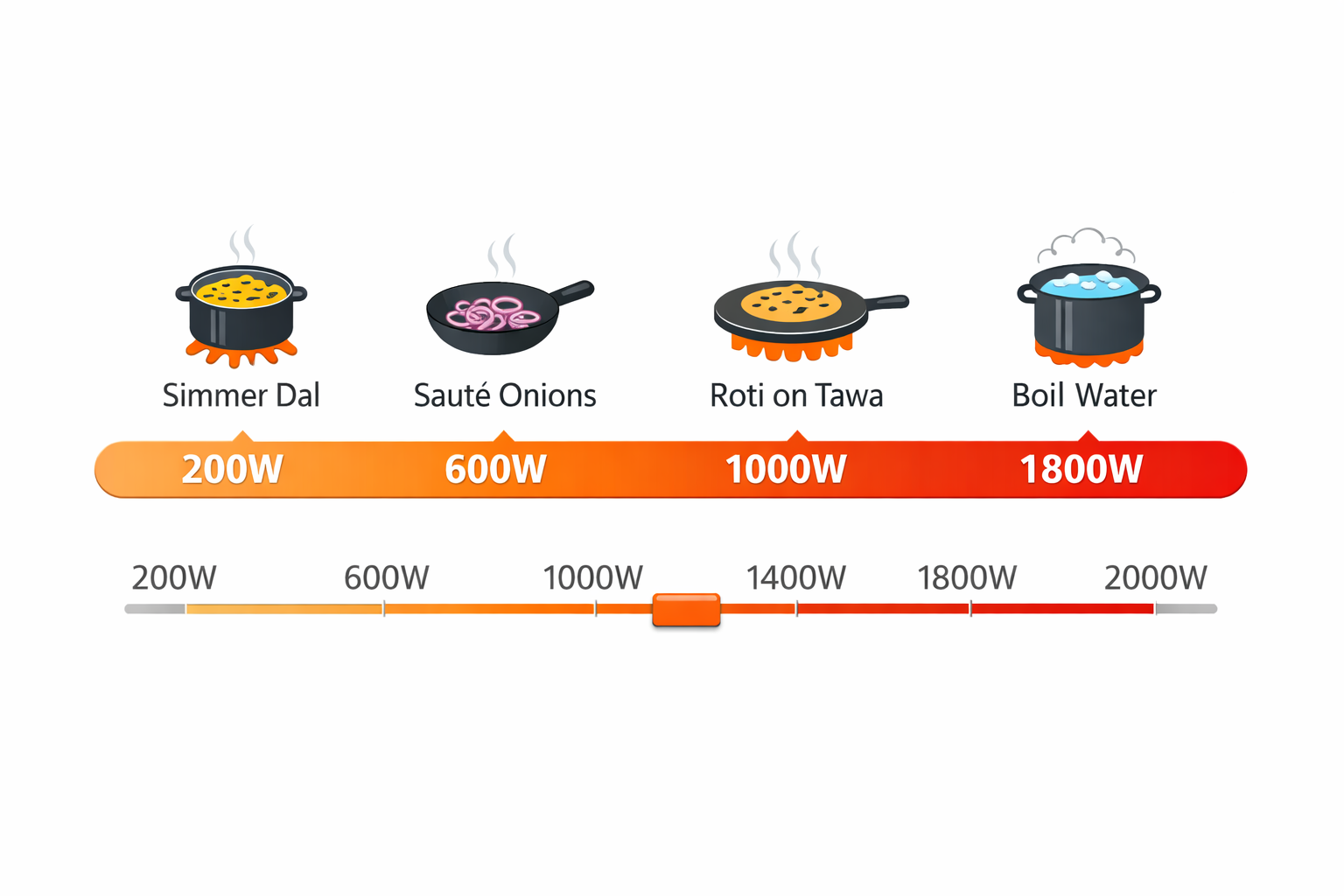
Gas gives you a visual flame to judge heat — but it's imprecise. Induction gives you exact wattage control, typically from 200W to 2000W in steps.
This matters for Indian cooking:
- 200-400W: Simmering dal, keeping food warm
- 600-800W: Making sabzi, sautéing onions
- 1000-1400W: Deep frying pakoras, making rotis on tawa
- 1600-2000W: Boiling water, pressure cooking
The precision also means no boil-overs — you can set an exact temperature and it holds it, unlike gas where small flame adjustments are hard to control.
Energy Cost: Induction vs Gas
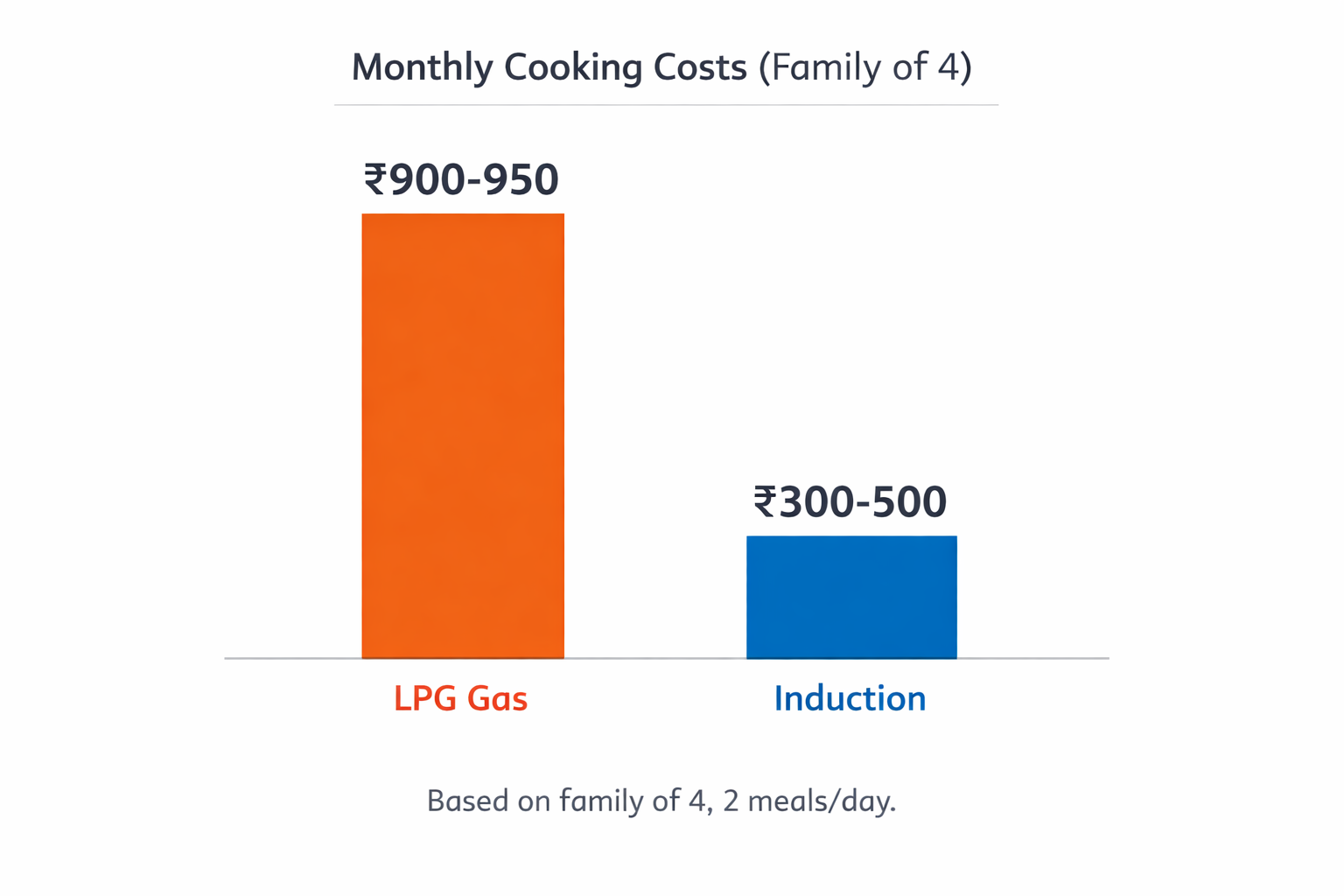
A common concern: "Won't electricity bills go up?" Let's do the maths for a family of 4 cooking 2 meals a day:
| Gas | Induction | |
|---|---|---|
| Monthly fuel cost | ₹900-950 (1 cylinder) | ₹300-500 (electricity) |
| Energy efficiency | 40-55% | 85-90% |
| Cooking time (same meal) | Baseline | 30-40% faster |
Induction is 40-60% cheaper to run than gas because of its higher efficiency. You use less energy to cook the same meal. Even at ₹8-10/unit electricity rates, induction wins.
The main caveat: power cuts. If your area has frequent outages, you'll need a gas backup. Most Indian families keep a single-burner gas stove as backup — which is a practical approach.
Common Myths, Debunked
"Induction radiation is harmful" — Induction uses non-ionising electromagnetic fields (like a wireless charger). It has been extensively studied and poses no health risk. The magnetic field drops to near-zero just 30 cm from the cooktop.
"You can't make rotis on induction" — You absolutely can, using a cast iron tawa. The trick is preheating the tawa on high (1800W) for 2 minutes, then dropping to medium (1000W). Rotis puff up exactly like on gas.
"Induction cooktops break easily" — The glass-ceramic surface is engineered for thermal shock resistance. Normal use — including placing hot pressure cookers on it — won't crack it. What does damage it: dropping heavy objects or sliding rough-bottomed pans across the surface.
Who Should (and Shouldn't) Switch
Induction makes sense if you:
- Want faster cooking with lower energy bills
- Have reliable electricity (or an inverter/UPS)
- Live in a rented apartment where piped gas isn't available
- Want a cooler kitchen (less waste heat)
Stick with gas if you:
- Experience daily power cuts of 2+ hours during cooking times
- Do heavy-duty tadka/bhunao that requires tossing the pan (lifting the pan breaks contact)
- Already have a fully functional gas setup and no reason to switch
Most households benefit from a hybrid setup: induction for daily cooking (dal, rice, sabzi, boiling) and a single gas burner for occasional high-flame work.
Key Takeaways
- Induction heats the pan directly through magnetic fields — 85-90% efficient vs 40-55% for gas
- It's nearly 2x faster than gas for most cooking tasks
- Any ferromagnetic cookware works — cast iron tawas you already own are perfect
- Monthly cost is 40-60% lower than LPG for the same meals
- Power cuts are the main limitation — keep a single gas burner as backup
Ready to buy an induction cooktop?
We tested and ranked the best induction cooktops available in India — from ₹1,500 budget picks to ₹8,000 premium models.
See Our Rankings →→